
This is not a post arguing for or against learning how to perform a classic pass, or turnover pass or any of the other passes. Learning to perform a pass is a good exercise to undertake, in part because learning to do a pass is also learning about misdirection and audience management.
But often it is just as mystifying to an audience to use a substitute for a pass, probably the most common one in use today is a double undercut. But I remember one that I learned back when I first got into card magic. It was from one of Blackstones books and was named the "Roly Poly Pass" as I recall. It was basically a fancy cut of of the cards. You can see it in my practice video below.
As I was playing with my "Charlier Undone cut" I realized that it could be used in a similar manner as the Roly Poly pass. If you simply performed the Charlier Undone to the point where the four packets were placed back together, all you had to do was to place the right hand cards so they trapped the top packet of the left hand, rather than the bottom packet. That put the selected card on top of the deck. Then doing the cut again, normally as a false cut, looked like the selected card was truly lost. Check out the video.
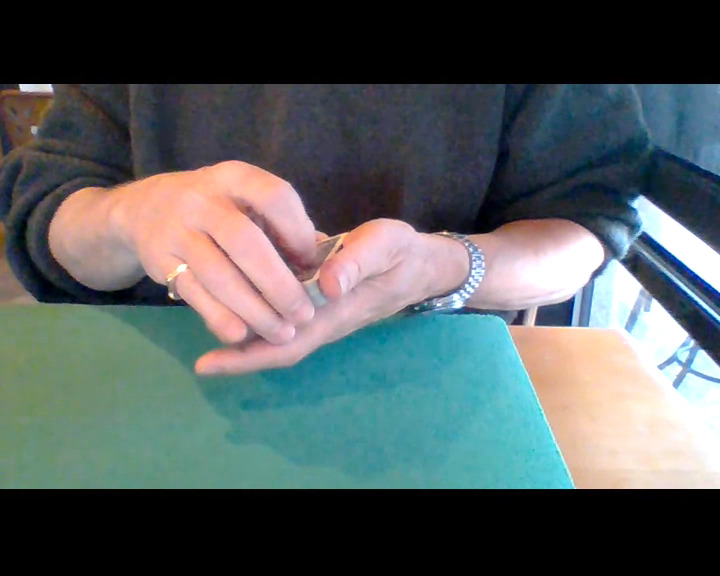
Start with a break above the selected card. In the video you see me dribble cards onto the card that is returned. This is a very disarming method of returning a card. By dribbling the cards tilted slightly downward and slightly injogged the cards will not align with the cards in the left hand. If you squared up the cards in the left hand before starting the dribble, you will find it easy to create a break at the injogged cards.
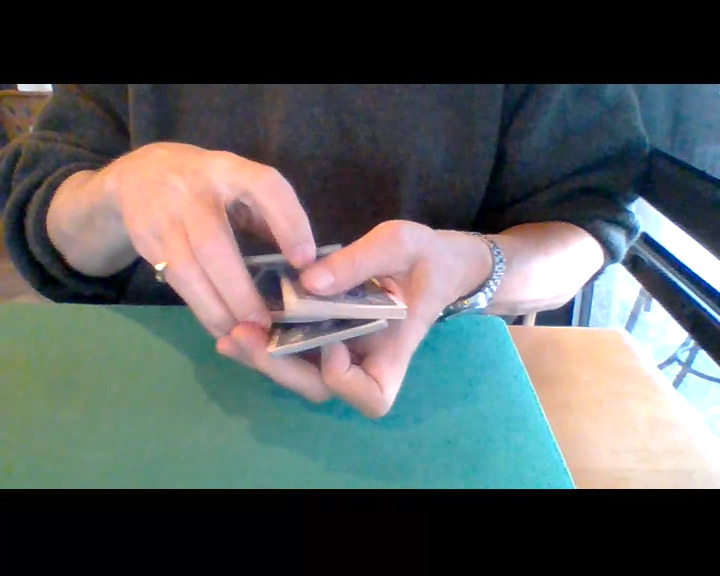
Now you start the Charlier Undone cut, first swing cutting a quarter of the pack above the break, and then pivoting the top packet to the break. This is different from the action in the Charlier Undone cut. In that cut you pivot the packet below what you raise with your right first finger. Refer to my post on the Charlier Undone cut. In this control you pivot the cards above the break instead.
The image to the left shows the point where the four packets are being recombined. At this point the selected card is the top card of the top packet in the right hand.
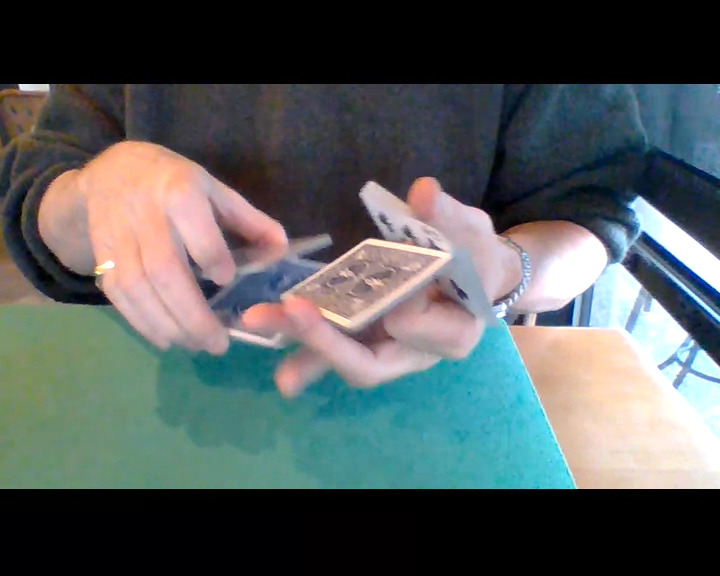
After completing the first Charlier Undone cut as an actual cut, now do a true Charlier Undone false cut. The image to the left shows that the right hand packets are now being placed below the left hand. The top card of the top packet in the left hand is now the selected card.