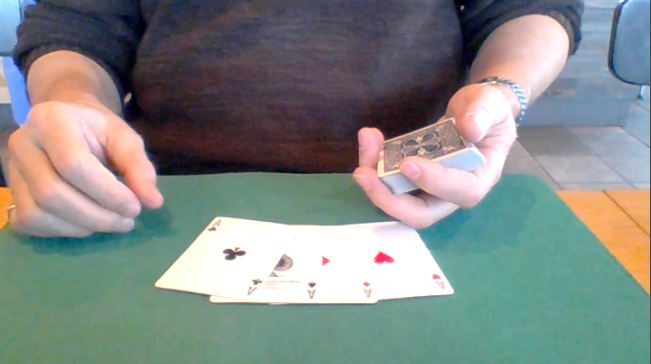
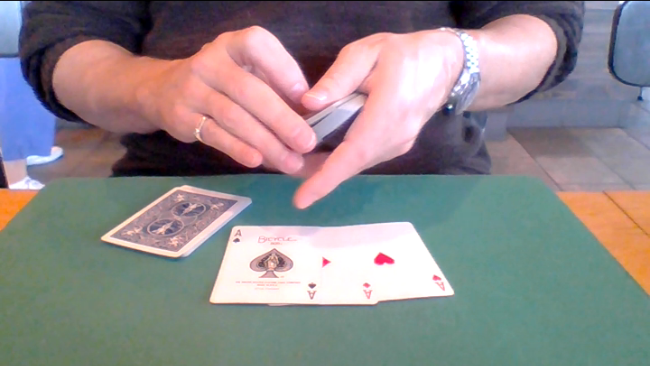
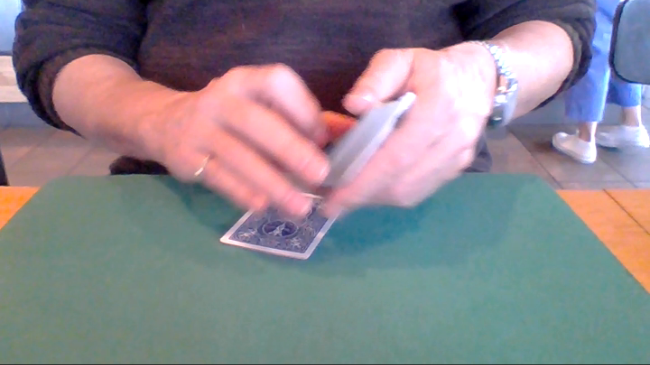
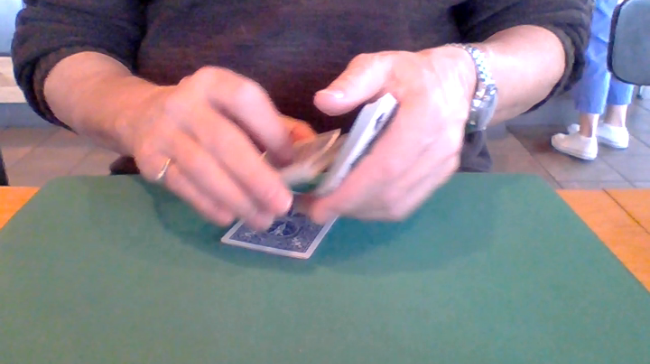
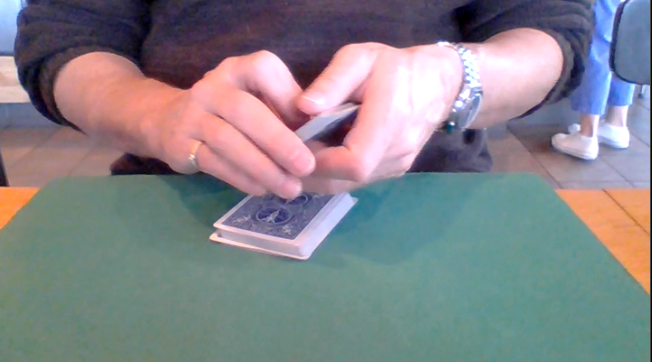
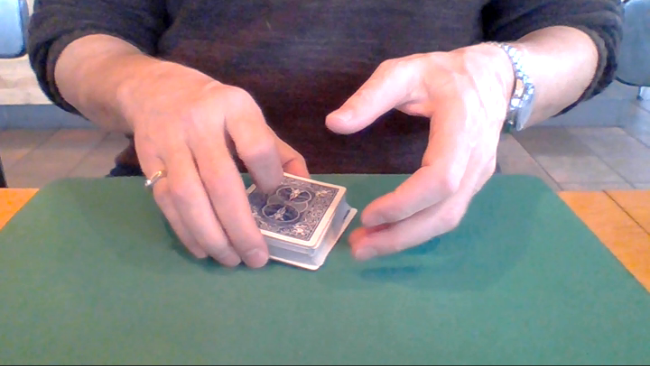
Este es mi propio control de ases. Parece muy justo, ya que cada as se inserta en la baraja y esta se corta varias veces. Entre cada inserción de as, se pueden mostrar las cartas superior e inferior. Tras insertar los ases y cortar, la baraja se baraja una vez y luego los cuatro ases vuelven a colocarse en la parte superior.
La columna de la izquierda describe las acciones de corte, mientras que la de la derecha muestra fotos y añade más detalles. Al final de esta publicación, encontrará un video que muestra la acción.
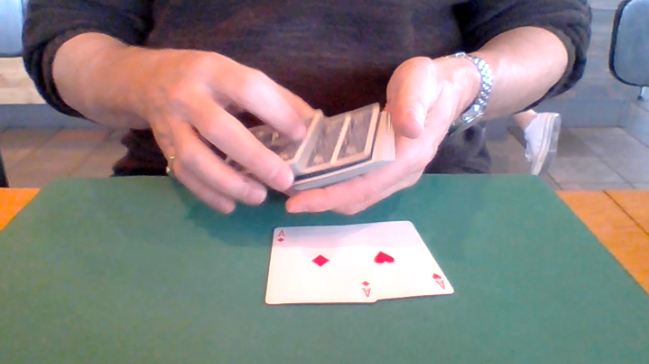
Comience con los cuatro ases boca arriba sobre la mesa.
Foto 1.
The first Ace
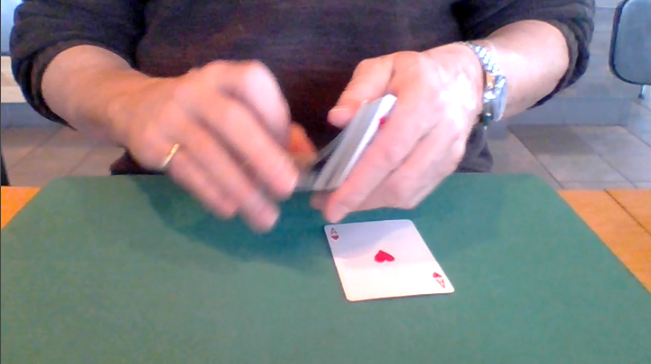
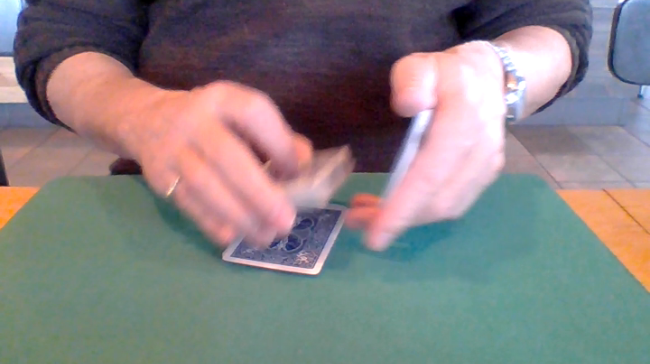
These are the steps for the first Ace: Take the first Ace and insert it into the middle of the deck. Keep a break above the ace. Now you will perform a double cut with a slip cut to place the ace second from the top. Start by cutting about a quarter of the deck from the top to the table. Then cut to the break, but with the left thumb hold the top card back, pulling out the cards between the top card and the ace. Drop those cards on the cards on the table. Finally drop the remaining cards on top of the cards on the table. The first Ace is now second from the top. The action should be done briskly and appear as if you have lost the Ace in the deck with a series of cuts.
Refer to the photos to the right for details.
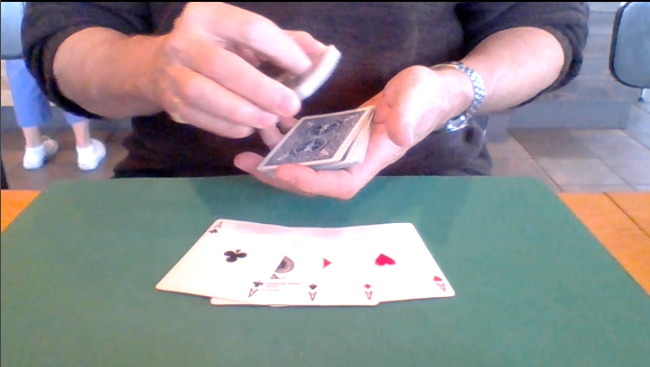
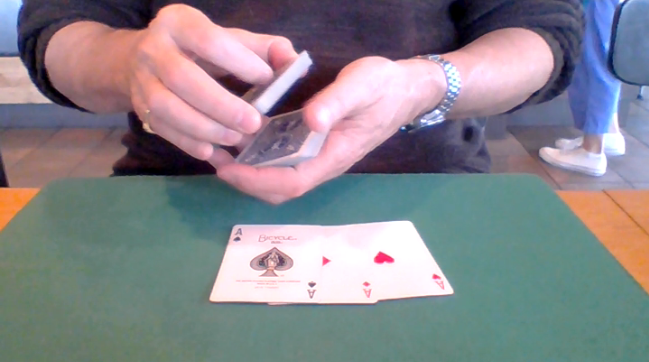
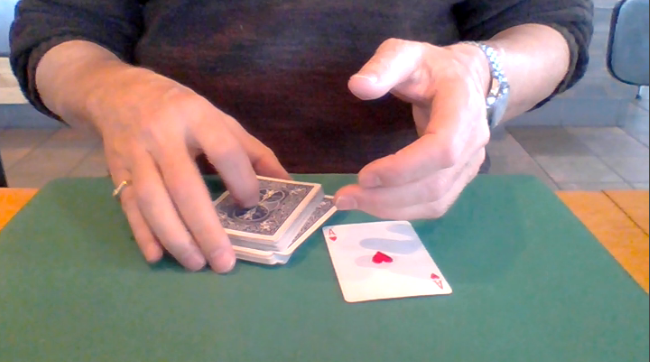
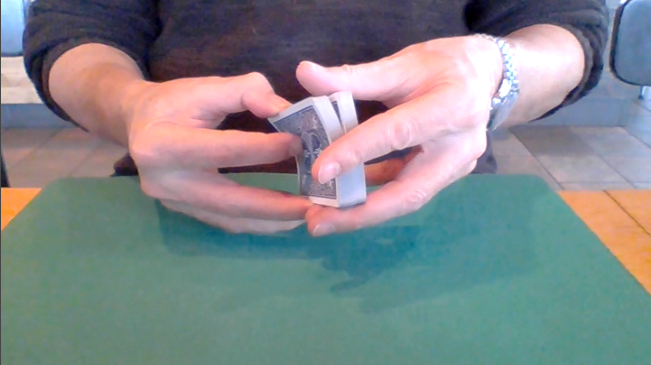
Photo 2. Dribble half the deck into your left hand
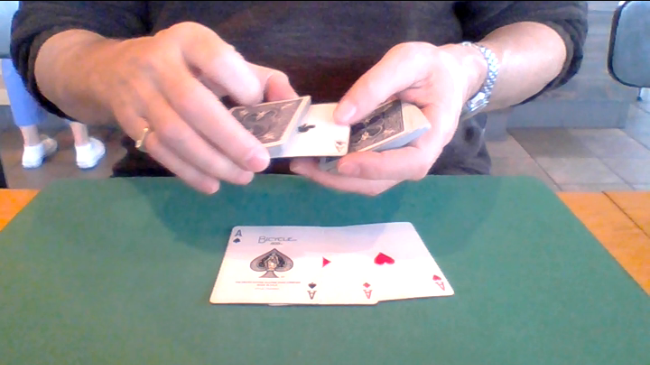
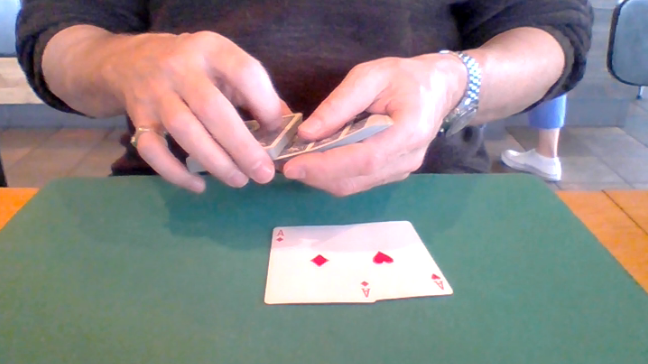
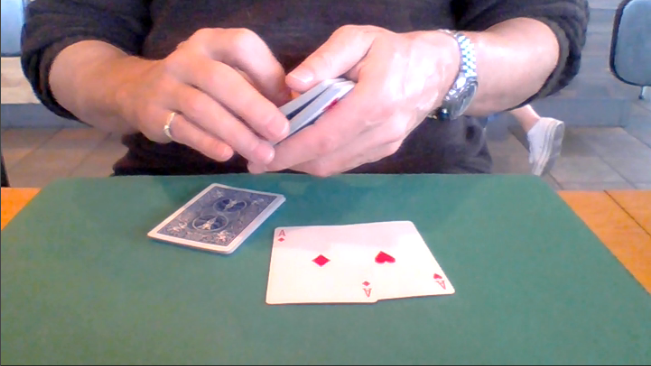
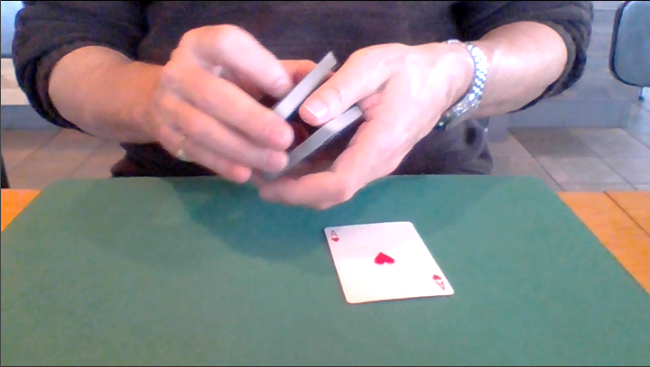
Photo 3. Pick up the first ace. Here I am about to flip the ace face down and side jogged.
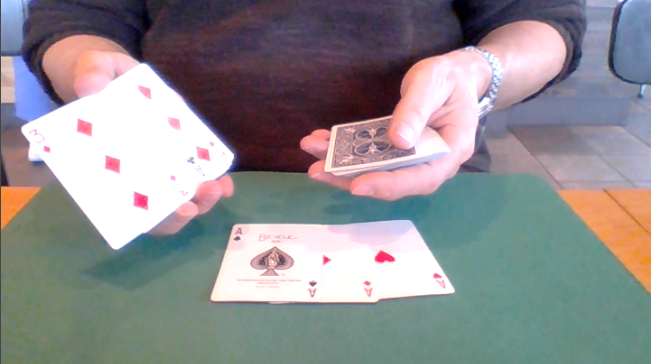
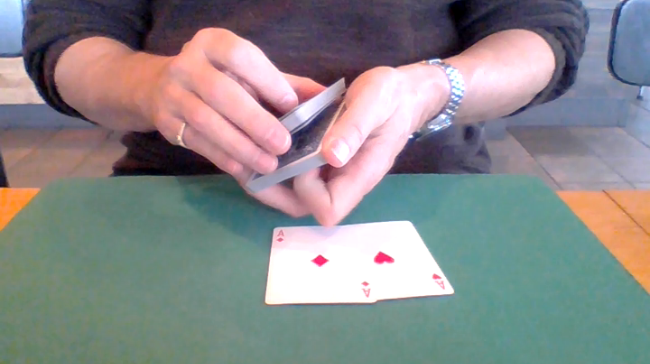
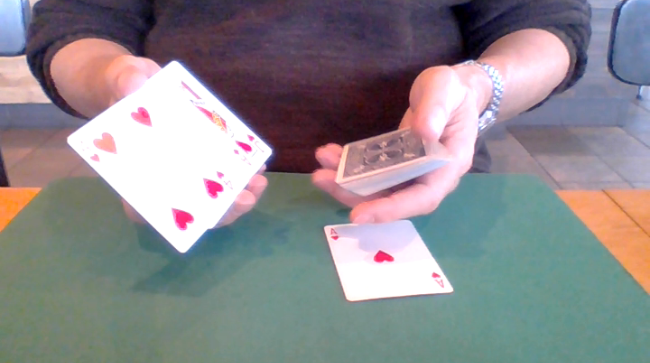
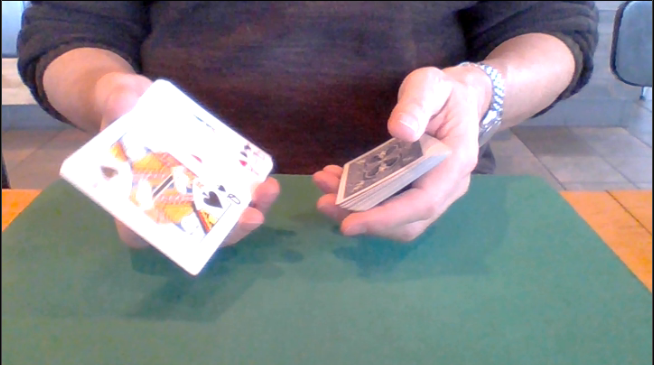
Photo 4. Here I side jogged the Ace as I placed it on the left hand cards and picked up the side jogged Ace and one card below it in the right hand. I rotate the right hand palm up to display the Ace. Rotating the hand back and replacing the right hand cards on top of the left, with the ace side jogged makes it easy to get a break above the Ace.
Photo 5. Here I have cut the top quarter of the deck to the table and am about to cut to the break. Note the left thumb which is positioned to slip cut the top card onto the Ace as the second quarter of the deck is cut to the table.
Finish by dropping the remaining cards in the hand on top of the cards on the table, then pick up the deck. The first ace is now second from the top of the deck.
The Second Ace
The second Ace is handled differently. Pick up the deck and cut it in half. I usually dribble about half of the cards from my right hand (holding the deck) into my left. With either my right or left hands (still holding their cards) I pick up one of the remaining Aces and place it side jogged onto the left hand held half. With my right hand I pick up the side jogged ace and one card under it, and turn my right hand palm up to display the cards, showing that the Ace is not next to the other ace.
The right hand turns palm down and places its half of the deck onto the left half, taking a break under the Ace this time. Because of the way the Ace was side jogged and displayed, this is very easy to do.
Now you are going to do another double cut to the table. But on the first cut hold back the top card (doing a slip cut) and pull out a quarter of the top of the deck and cut it to the table. The top card of this quarter is the first Ace. Now cut to your break and drop those cards on top of the tabled cards. This puts the two aces together about a quarter of a deck from the bottom. Drop the remaining cards on top.
You can show several bottom cards and several top cards to be indifferent cards at this point if you wish.
Photo 6. Here I have dribbled half of the deck into my left hand and am about to pick up the second ace, the Ace of spades.
Photo 7. I have picked up the Ace of Spades, side jogged under the right hand cards an am pushing over the top indifferent card from the left hand pack, in preparation for displaying the Ace.
Photo 8. I have rotated my right hand palm up to display the cards, showing the the Ace is not next to another Ace.
Photo 9. I have rotated the hand back palm down. Note how the side jogged cards are aligned with the pack in the left hand. This makes is easy to take a break under the ace as the deck is squared up.
Photo 10. Here I have slip cut the top quarter of the deck to the table. The Ace of Spades is on top of the tabled cards. I am about to cut to the break. That cut has the Ace of Clubs on the face and when I place the packet on top of the tabled packet those two Aces will be together.
The Third Ace
Now repeat the moves that you performed with the first Ace, with the third one. Briefly, insert into the middle, hold a break above, cut a quarter from the top to the table, cut to the break doing a slip cut action with the top card, and cut the the break. Again, this puts the third ace second from the top.
It also moves the two aces that were a quarter of the way from the bottom, to about a quarter of the way from the top.
Photo 11. This time I riffled down the deck with my left thumb instead of dribbling the cards. I am about to pick up the Ace of Diamonds.
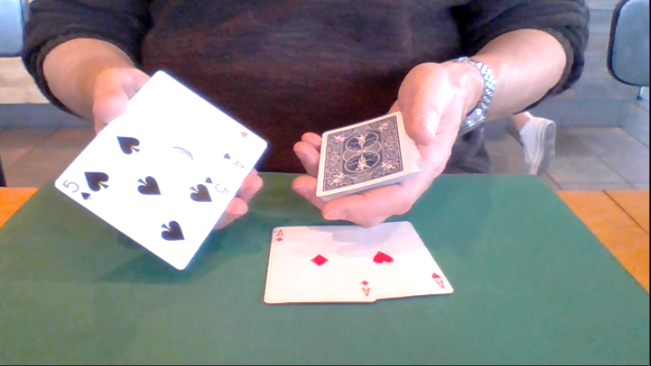
Photo 12. I have picked up the Ace of Diamonds and am showing the cards above and below it as before.
Photo 13. I have placed the displayed cards back and have taken a break below the Ace of Diamonds. This photo shows the slip cut of the top indifferent card as my right hand cuts the top quarter to the table.
Photo 14. Here I have finished the triple cut. Note that I purposely have made these cuts sloppy. The cards are not squared. This is important as you will see with the fourth ace.
The Fourth Ace
Now things change up for the final ace. Put the ace into the middle of the deck as you did for the second ace and take a break under it. But this time, when you cut, do a light strip cut of about an eighth of the deck (losing the top card). Cut to your break but as you place the cards down onto the eighth of a deck on the table, side job the bottom card to the right slightly. I do this using my left middle finger. As my right hand comes over to cut to the break, as the cards are lifted, my left middle finger touches the bottom card of the right hand packet and by extending the left middle finger slightly, it side jogs the bottom card (an Ace). The right hand places the cards onto the tabled cards. The right hand come back and takes the remaining cards and places them onto the rest of the tabled cards.
Now pick up the deck from the table and place it in your left hand. As you do so, the left little finger pulls down on the side jogged Ace and takes a break above it. Do another double cut, with the first portion being between an eighth and a quarter of the deck, cut to the table. Then cut to the break, and then finish the cut with the last packet.
At this point you should have two aces on top and two aces most likely just below the center of the deck. Since you know roughly where the centered aces are it is a simple matter to take the deck in the hands and to riffle up the side as you break the deck in half to do a shuffle. As you riffle up, look for the aces and break the deck in half just above them.
Now you have two aces on top of each half. Shuffle the halves together to bring all four aces to the top.
Photo 15. Cutting the deck for the last ace.
Photo 16. Displaying the ace.
Photo 17. Cutting about an eighth of the deck (say nine cards) to the table.
Photo 18. Cutting to the break. The fourth ace is the bottom card in my right hand. My left middle finger has slightly side jogged it to the right.
Photo 19. Here I am about to drop the remainder of the deck onto the tabled cards.
Photo 20. Pick up the cards from the table with your right hand and place the deck into your left hand. As you do, your left little finger finds the side jogged ace about 10 cards from the bottom and pulls down on it, taking a break above it.
Photo 21. Now to another cutting sequence. Cut about an eighth to a quarter to the table, cut to your break, and the drop the remainder on top.
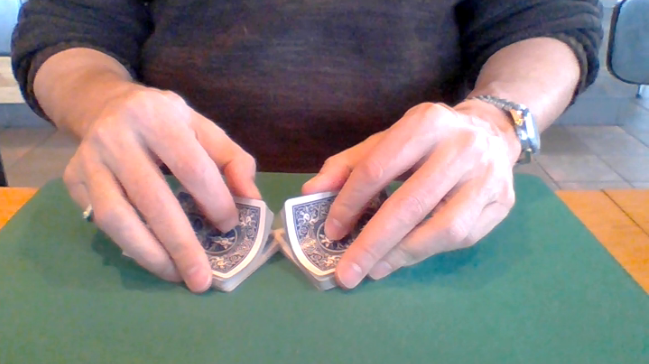
Photo 22. There should now be two aces on top of the deck and two near the middle. If the two are not near the middle you will have to play around with the final cut sizes. Here I am breaking the deck in half, at the two aces so I can shuffle.
Photo 23. Each half has two aces on top. At the completion of this shuffle all four aces are on top of the deck.