
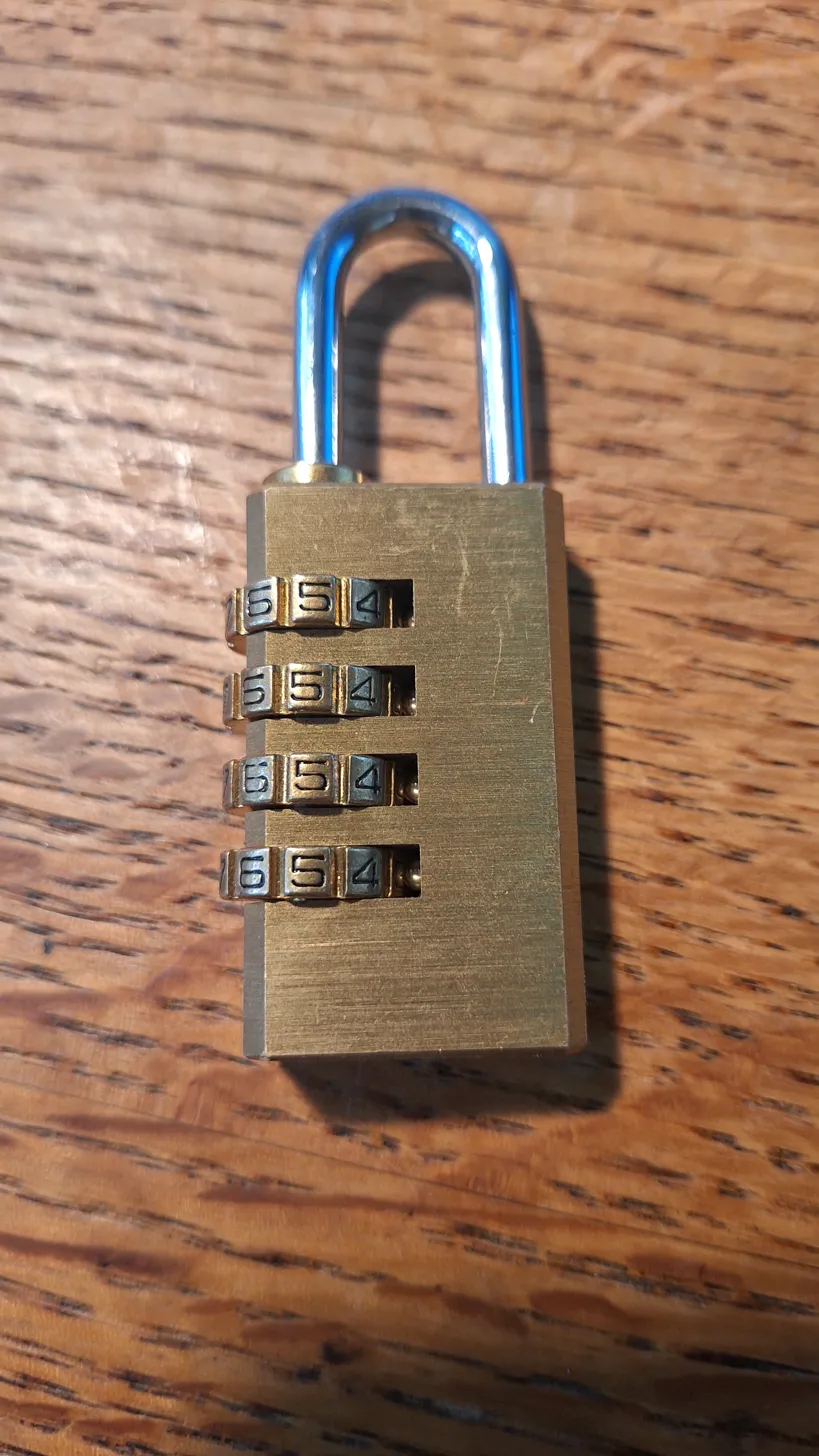
I recently found an old “Dream Lock,” a four-wheel combination lock with a unique feature: it can be rigged to open using only two of the four dials. This meant I needed a reliable way to make a spectator select my two target numbers out of four digits they would pick.
I decided to use the classic “Cut Deeper” Force from card magic.
The Procedure (Target: 4 and 2)
For this explanation, assume the lock is set to open with 4 and 2.
1. Pre-Setting the Deck
- I have the spectator shuffle the deck. I take it back and spread it face-up to show the cards are mixed.
- The Cull: As I spread, I secretly locate one target card (e.g., the 4) and subtly move it behind the spread. I then find the other target card (the 2) and position the culled card next to it, making the sequence 4-2.
- I close the spread, take a break above these two cards, and cut the deck at the break. This places the 4 and the 2 on top of the face-down deck.
- I may throw in some false cuts and shuffles to maintain the illusion that the deck is still mixed, keeping the top two cards in place.
2. Forcing the First Number (The 4)
- I explain and demonstrate the action: The spectator is to cut a packet off the top, turn it face-up, and replace it on the rest of the cards.
- I spread the cards to find the point where the face-up and face-down cards meet. The first face-down card is always the first force card: the 4.
- I take the face-up cards in my right hand and use my left to thumb off the 4 to the table. I then rotate both hands, placing the large packet face-down onto the table. I place the left hand packet (now face-up) onto the tabled cards.
- Note: This turnover effectively brings the next force card (the 2) to the new top of the deck.
3. Forcing the Second Number (The 2)
- I instruct the spectator to “Cut Deeper” and repeat the process: cut a packet, turn it over, and place it on top.
- Spreading the cards again, the first face-down card is the next force card: the 2.
4. Completing the Combination
- I repeat the “Cut Deeper” process two more times for the final two numbers. Since the lock only requires the first two digits (4 and 2), the last two are indifferent. Depending on where the division is between the face up and face down cards I might ask if the spectator wants to turn the entire deck over.
- The spectator has now “selected” four cards, resulting in a combination where the crucial first two digits are the exact numbers needed to open the Dream Lock.
This method reliably gives me the two numbers I need while making the entire selection process appear random and fair to the spectator.
Additional thoughts
Instead of the cut deeper force I sometimes stack the 4 and 2 on top, and place 5 face cards in the middle of the deck. I then take the deck out and split in half at the 5 face cards. Placing both halves on the table I ask the spectator to shuffle them. This almost always guarantees that the first number cards dealt after the shuffle will be the 4 and 2. I tell the spectator that we need 4 number cards so I discard the face cards as I come to them.