
First let me describe the classic Hummer Trick.
It’s a beautiful card trick that looks like genuine mind reading, yet requires no sleight of hand, no marked cards, and practically no skill. All you need are three cards and an understanding of simple logic.
The Effect
You deal three cards face up in a row on the table. After secretly noting the center card, you turn away and ask a spectator to choose one of the three cards and remember it. Here’s what happens next:
- The spectator turns their chosen card face down
- They swap the positions of the other two cards
- They turn those two cards face down as well
Now all three cards are face down, and their positions have changed. You turn back around and invite the spectator to mix the cards freely, moving them around the table to different positions. You track one specific card during this mixing process.
When the spectator is satisfied, you pause dramatically, concentrate, and then confidently turn over one card. Either you’ve found their card directly, or you instantly know which of the remaining two cards is theirs. It never fails.
The Method
The secret is elegantly simple. You memorize the center card at the beginning. When you turn back to face the spectator after they’ve performed the swapping procedure, you track the card that is now in the middle position as the spectator mixes all three cards.
When ready, you turn over the card you’ve been tracking. Here’s the beautiful logic:
If it’s your original center card: This means the center card never moved during the swap. That can only happen if the spectator chose the center card as their selection (it was turned face down but stayed in place, while the other two were swapped). Therefore, the card you just revealed IS their selection.
If it’s NOT your original center card: This means your original center card was moved during the swap (to either the left or right position). Since the spectator swaps the TWO cards they didn’t choose, and your original center card was moved, that means it was NOT their selection. The card you just turned over is also not their selection (because it was one of the two cards that got swapped). Therefore, by process of elimination, the third card—the one you haven’t accounted for—MUST be their selection.
Why This Works So Well
The beauty of this trick lies in its ironclad logic disguised as chaos:
- There are only three cards and three possible selections
- By tracking what happens to your memorized center card, you create a binary test
- If the center position still contains your card = they chose the center card
- If the center position contains a different card = they chose the third card (the one that’s neither your memorized card nor the card now in the center)
The spectator feels they have complete freedom, and the swapping procedure seems to hopelessly scramble things. Yet your knowledge of one card’s identity creates a logical key that unlocks the mystery every time.
Performance Tips
To make this truly magical:
- Be casual about remembering the center card. Just glance at the three cards naturally as you lay them out
- Sell the difficulty. Act like tracking cards while mixing requires intense concentration
- Give the spectator real freedom in mixing the cards at the end—you’re only tracking one card, which is easy
- Master the two revelations. If you turn over your original center card, immediately announce it’s theirs. If you turn over a different card, turn over the other two and pause meaningfully, then point to the remaining card and that you know is the selection and say “Then your card… must be this one”
This trick proves that the most powerful magic doesn’t always require difficult technique—sometimes it just requires understanding a principle of logic that your audience will never suspect exists.
The App
I wanted to create a web app to do this trick when I don’t have a deck of cards. One advantage of using the app is that the swap of the two cards is done without the spectators knowledge.
Open the web page at https://robertjwallace.com/threecard/

Click the start button
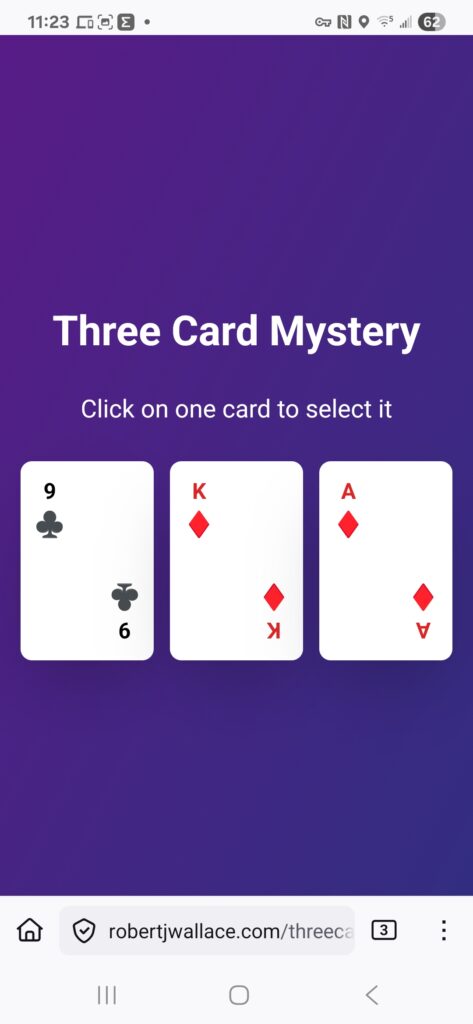
In this case, you remember that the middle card is the King of Diamonds. You turn away and have the spectator chose a card by clicking on it. Let’s say they click the 9 of clubs. That causes the cards to turn face down.

They click the “Got it” button and you turn around to face them. Unlike the version with real playing cards, you don’t have to track anything, the app does it for you.
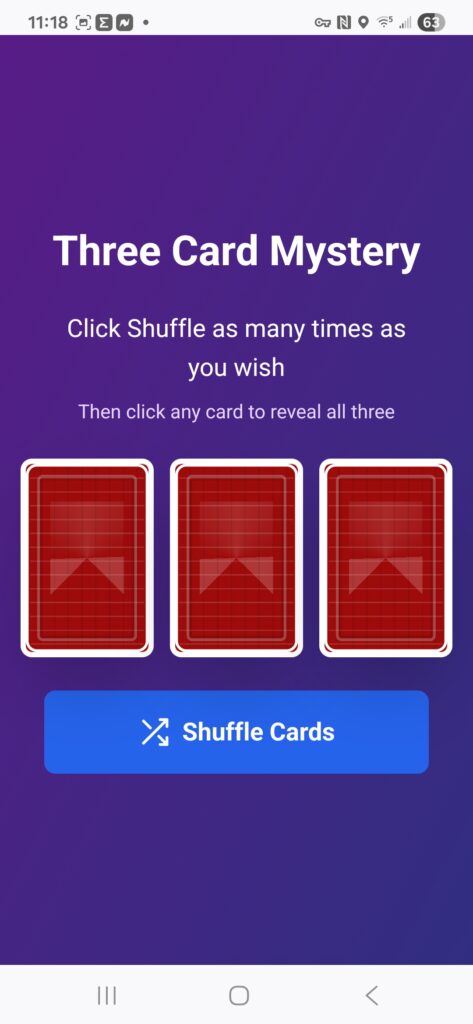
You or the spectator can click the “Shuffle Cards” button as many times as you want. Note that this really shuffles the order. Then you or the spectator can click on one of the cards. You have to see which card was clicked. The app automatically makes this card the card that you would have been tracking if you were using real playing cards.
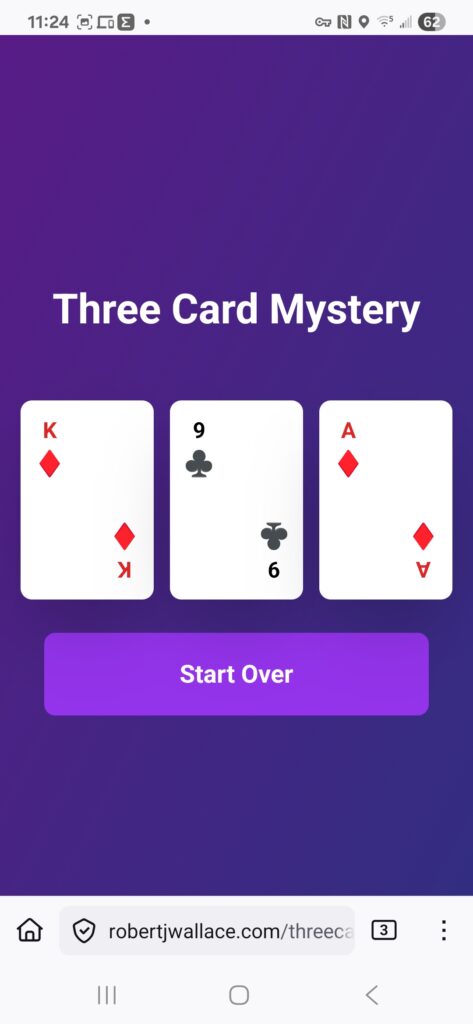
In this case, they clicked the right most card, the Ace of Diamonds. Since you know that the King of Diamonds was the original center card, you now know that the 9 of clubs was the card they chose.
The drawback of using an app is that the spectators will assume that the app is rigged, and will offer suggestions as to how it is done. For example, one spectator thought that the selection was always on the left. No one has actually figured out how the selection is found, but they assume the technology did it. I show them the effect several times, and explain that I can also do it with real playing cards.
So I asked an AI to create a bibliography for the effect and this is what it came up with. I have not checked it for accuracy.
Bibliography for the Three Card Mind Reading Effect
Based on AI research, here is a bibliography for this three-card mind reading effect:
Primary Sources
Hummer, Bob. Mathematical 3-Card Monte. Frank Werner, 1951. 2 pages.
- This is the original publication of the effect by its inventor, Bob Hummer. Published as a small pamphlet by Frank Werner, Hummer’s friend and publisher.
Gardner, Martin. Martin Gardner’s Sixth Book of Mathematical Diversions from Scientific American. W.H. Freeman (later reprinted by University of Chicago Press), 1971.
- Gardner featured Bob Hummer’s effect in this collection of his Scientific American columns, helping to popularize it beyond the magic community. Harry Lorayne’s variation (which can be performed without looking at the objects, even over the phone) was first published in this book.
Lorayne, Harry. Mathematical Wizardry: How to Perform Feats of Mathematical Wizardry. Harry Lorayne Inc., 2005 (approximately).
- Lorayne includes both the classic Hummer version and his own variation where the performer doesn’t need to look at the objects to divine the selection.
Additional References
The effect has also been referenced and taught in various magic publications and online resources, including:
- Multiple mentions on magic instruction websites like GoodTricks.net and Trickla.com
- Discussion in magic forums including The Magic Café
- Featured in Matthew Furman’s online card trick tutorials (attributed to Bob Hummer and the Buck Twins)
Historical Context
Bob Hummer (1906-1981) was an eccentric magician who invented numerous self-working effects based on mathematical principles, including the Whirling Card and Poker Chip Mystery. Genia Magazine His methods were often deceptively simple, relying on subtle, math-based principles that he worked out without any formal training rather than sleight of hand. Trickshop
The Mathematical 3-Card Monte has been adapted by various magicians over the years. Shortly after its release in 1951, Al Koran adapted Bob Hummer’s Mathematical Three Card Monte to locate a crumpled up banknote secretly placed under one of three cups. Trickshop
If you’re looking to study this effect in depth, I’d recommend starting with Harry Lorayne’s Mathematical Wizardry, as it’s the most accessible modern source and includes both the original method and Lorayne’s enhancement.