
Esta es una de las tramas clásicas de cartomagia. Tiene muchas variantes. Archivo de conjuros Se enumeran más de 100 entradas al buscar el título. La trama básica consiste en que se invita al espectador a cortar la baraja y, mediante una ingeniosa estrategia, los ases acaban siendo revelados al cortarla. Una de las primeras versiones se publicó en The Royal Road to Card Magic, titulada "Picnic del Jugador de Póker". Esta versión sentó las bases para muchas de las posteriores, con la baraja cortada en cuatro montones sobre la mesa.
In these versions the aces are usually on top of the deck and then the deck is cut to make four piles on the table. The aces are secretly added to the top of three of the piles, either by dealing (as in “Poker Players Picnic”, or with sleight of hand. I was playing around with different versions, and when thinking about it I realized that one solution would be to force the spectator to actually cut to the aces. Since there is a “cut” force I decided to play around with the idea. Of course I am referring to the “Cut Deeper Force”.
The cut deeper force
You probably know this already. Begin by asking a spectator to cut roughly one-quarter of the deck. Have them flip that portion over and place it on top of the remaining cards. Then, request a deeper cut—about halfway down—and let them repeat the process. These two cuts work together to shift your force card into the exact position you need, as the first face down card when the deck is spread.
Using the cut deeper force for this effect
So I played with this a bit. By having the four aces on top of the deck, and performing the steps four times, the result was that the spectator cut to the four aces.
But because of the repetition I felt an astute spectator might figure out what was going on. Also, there were eight cuts involve, with made the effect drawn out. I wanted to “cut” it down to only four cuts. This is what I came up with so far.
Again, secretly have the four aces on top of the deck. I sometimes let the spectator shuffle and then use my two-step cull. Other times I already have the aces on top and do a false shuffle and/or cut.
Have the spectator lift up about 1/4 of the deck, about an inch off the deck. Take that packet from the spectator and thumb off the card they cut to. Turn the cards that they cut off, face up, and return them to the top of the deck.
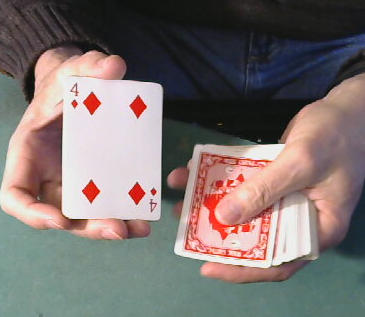
This first card is an indifferent card. The four aces are at the back of the face up cards that are on top of the deck. Be careful not to expose them. Ask the spectator to cut deeper, perhaps around 1/2 of the deck, raising the cut off portion about an inch. Take those cards from the spectator and rotate them, placing them on top of the deck. This is the first “force”. The four aces are the first four face down cards, under the face up block.
At this point, there usually a natural break between the halves, so you could simple cut to that break to thumb of the first face down card. But since you are clean at the point, I spread the face up cards, commenting that they could have cut to any of those cards. When reaching the first face down card I thumb it off to the table.
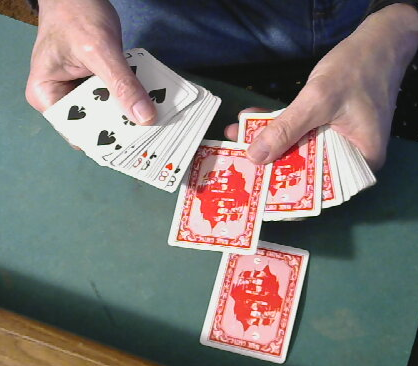
I replace the face up cards, and have the spectator make a third cut. This time the aces are in the face up block and they are cutting to another indifferent card. I cut to the natural break, and turn my wrist as I thumb off the third “ace”, really an indifferent card..
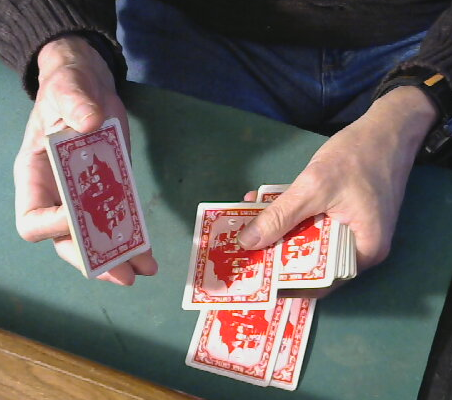
The last three aces are at the back of the face up cards.
Repeat the spectator cutting action one more time to force the second ace. On this last cut you can spread the face up cards. Thumb of the first face down card (an ace), and take the face up cards and turn them over, replacing the onto the bottom of the deck.
Situation check: two aces are on top of the deck and on the table are four cards, from the bottom, X, A, X, and A. Now you are going to switch out the two X cards for the two aces on top of the deck.
The deck is in your left hand. Reach with your right hand to pick up the top card of the pile on the table. Two things happen at the same time now. Your left thumb pushes off two cards to get a break under the aces on top the the deck. Your right hand takes the top card of the tabled cards and uses it to pick up the others, but sliding it under them. This changes the order from X, A, X, and A, to A, X, A, and X.
Place the four tabled cards on top of the deck, adding the two aces above the break to that packet as you use your left thumb to slide of the top card from the packet onto the deck. That is an indifferent cards.
Slide the next card, an ace, off the packet onto the deck, but keep a left little finger break under it.
Slide the next card, the other indifferent card off the packet. As the packet comes over the deck, add the Ace that you have the break under to the bottom of the packet. Place the packet on top of the deck.
You now have the four aces on top. I spread them off and take them in a face down fan with my right hand and raise the hand to display them.
Resumen
This certainly is no better than other methods, but it does offer one advantage in certain circumstances. It requires little to no table space. If you don’t have a table you could use another spectators hands as a “table”, or place the cut off cards in your shirt pocket.
Go ahead and play around with it.
Afterthought
This cutting could also be used as a poker trick. Start with four aces on top. Spectator does a cut and you deal them the face down card. Replace the cut off cards face up. Spectator cuts deeper and you deal the first face down card to you. Repeat this three more times and you have four aces dealt to you.