El barajado Faro es una técnica de barajado que permite que dos paquetes de cartas se intercalen perfectamente. Es decir, solo se suelta una carta de cada paquete a la vez, alternándose con una carta del otro paquete. Es una técnica semiautomática, lo que significa que, al ejecutarse correctamente, las cartas se entrelazan sin esfuerzo por parte del barajador. Sin embargo, es una técnica que se debe dominar, y factores como el estado de las cartas, el agarre de los paquetes, la presión y los ángulos también influyen.
The shuffle is also known as a weave shuffle (British) and as a dovetail shuffle. In America it is called a Faro shuffle because of its usage by Faro dealers. Faro was a popular gambling game in America during the 1800s.
There are several different ways of performing the shuffle. The weave of the cards can be started from the bottom of the deck, or from the top. In addition, with both types of weaving, the top card of the deck can remain the top card, called an out shuffle, or the top card can become the second card down after the shuffle, called an in shuffle.


One of the earliest detailed descriptions of the shuffle was in 1940 with the publication of “Expert Card Technique” by Hugard and Braue. Ed Marlo published extensively on the shuffle in the late 1950s.
These are the techniques and tips I use to perform and practice the shuffle.
First you should practice with a deck in good to excellent condition, especially as you are learning. You should practice doing perfect shuffles, which are where the deck is divided exactly in half with 26 cards in each packet. I recommend putting the deck in new deck order and practicing out shuffles. The reason for this is that it can give you known cards to cut to to split the deck exactly in half.
A key goal of your practice is learning to cut the deck (or part of a deck) exactly in half. With the deck in new deck order you can check where you split the deck. Holding the deck in both hands use your right thumb to split the deck apart. Look and compare the ends of the cards and see if they have the same number of cards. Now look at the face card of where you cut. If you cut at 26 the face card should be the King of Clubs. If it isn’t the King of Clubs close and square the deck and try again.
One of the key features of the Out Shuffle is that eight of them will return the deck into the original order, in this example back to new deck order. (You can check this out with my faro simulator.) So there will be eight different key cards you can use to check your cuts. For the first shuffle the cut is at the King of Clubs. For the second shuffle the key is the Ace of Diamonds.
| Shuffle Number | Key card to cut to |
|---|---|
| First Shuffle | King of Clubs |
| Second Shuffle | Ace of Diamonds |
| Third Shuffle | Seven of Clubs |
| Fourth Shuffle | Four of Diamonds |
| Fifth Shuffle | Nine of Spades |
| Sixth Shuffle | Five of Spades |
| Seventh Shuffle | Three of Spades |
| Eighth Shuffle | Two of Spades |
I recommend that when you first start learning that you don’t complete shuffles that haven’t weaved correctly. Un-weave them, but the deck back together and try again. I will demonstrate this is the video clips below.
There are some basic techniques that are common whether your are doing a top down weave, a bottom up weave, an in shuffle or an out shuffle. As for the top down versus bottom up techniques I find that some people find one way to be easier or more natural for them than the other. I recommend practicing both. Darwin Ortiz does a top down Faro, his reasoning being that there are tricks and effects that don’t need a full deck weave. I typically do a bottom up Faro because visually it looks more like a normal shuffle. I will demonstrate both.
In addition to the above differences I have also found that people handle the two packets differently. I hold the deck in my hands and cut of the top half with my right hand and move it back towards my body. Some performers move the top half forward away from their body.
I have found a lot of mathematical articles describing the math behind the Faro shuffle. To my surprise I have not found anything describing the physics of the shuffle. The shuffle basically involves butting the two halves together and applying pressure to get them to spring together perfectly interleaving. Factors that affect this interleave are:
- The conditions of the cards
- The grip on the cards and keeping the cards square to each other
- The surface area of the cards touching as they weave together
- The pressure being applied pushing the two packs towards each other and sometimes the release of the pressure on the two packs
The conditions of the cards
I have done perfect Faros with ratty old decks but it isn’t fun. A new deck, or a deck just broken in is the best. It should be clean and have no crimped cards or bent corners.
The grip on the cards
The grip on the cards is very important.

The deck is held square between your right and left hands. The left hand is slightly palm up and the deck is held between the left thumb and middle fingers near the outer end. The left first finger is pressed at the end of the deck keeping it square. The right thumb and middle fingers hold the inner end of the deck with the right first finger pressing down slightly on the backs of the cards. The goal here is to keep the deck as square as possible and you cut it into two packets between the 26th and 27th cards.
While maintaining pressure with your grip use your right thumb to split the deck in half. At this point look at the two halves to see if they are equal.

Then slide the top half back and line up the two halves.

By butting the two halves together you can check to see if they both have the same number of cards. If they don’t, put the top half back, re-square the deck and cut again. Note that the hands are still tightly gripping their halves and that the left first finger is keeping its half square.
You don’t have to butt the halves together, you can go directly into the shuffle, but I find butting the halves together helps square them and gives a good check for having cut the deck exactly in half. I also extend my left little finger down to the point where the two halve will meet and use the tip as a ledge to rest the ends on.


The weave
You are now ready to weave the cards. At this point I am showing a bottom up weave.
The weave is controlled by a number of factors. A key factor is the friction that has to be overcome, and the pressure of the two halves pressing against each other. With each half butted square to the other there is too much friction to overcome. You need to minimize the surface that the cards touch.
So there are two things being done at the same time. The two halves are being slightly rotated to a “V” shape as you slightly push the halves together. Pushing the halves together, in a bottom up weave, with cause the ends of the halves to raise up. In the bottom weave as you push the halves together your hands will slightly bend down, while in a top weave they will bend up and the cards with form a downward bend.
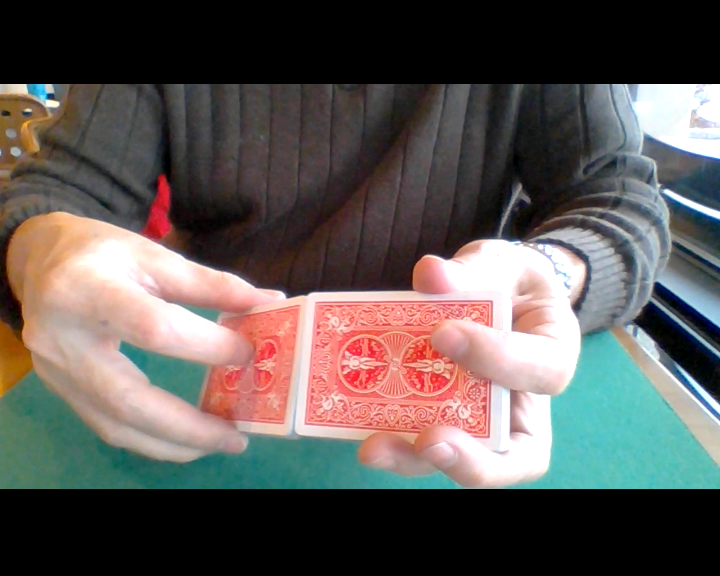
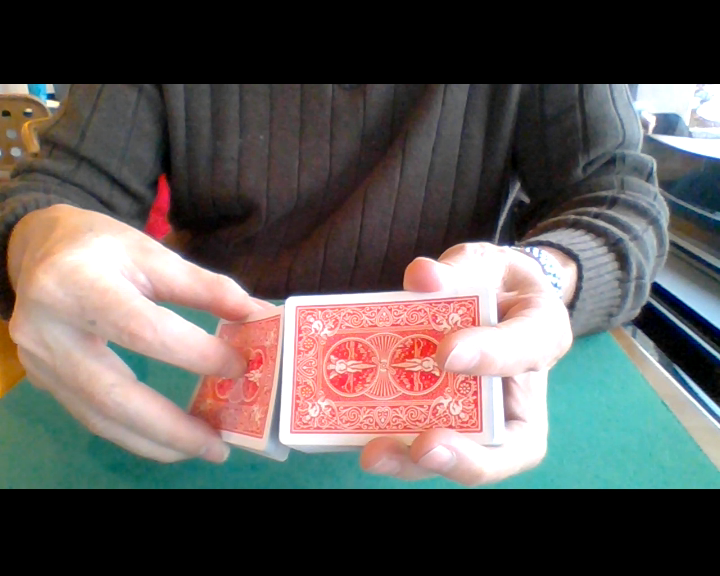

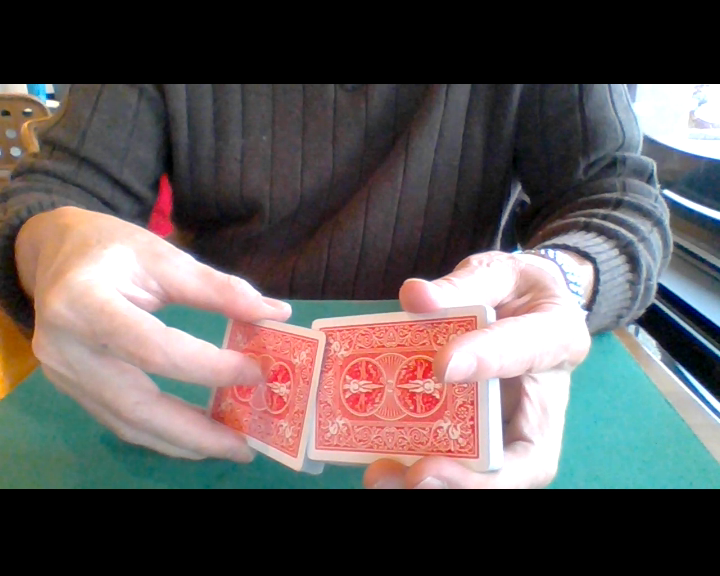
Note that the grip on the halves is still at the ends. This allows the cards enough flexibility to easily weave. Normally the cards will weave together rapidly with a satisfying soft whir sound. But you can control the speed of the weave by adjusting the pressure of the hands towards each other.
Common mistakes at this point are applying too much pressure. Where the cards are touching the deck should only move upwards slightly. Also you should not have to move the halves in a back and forth sawing motion. The slight rotation to minimize surface area and pressure is all you need. If the weave stops try releasing a little pressure and/or rotating the hand a little bit more. Seldom should you have to add pressure by pushing the hands together.
With the deck woven like this you can look at the sides to see if the weave was perfect or not. A perfect weave will look like this:
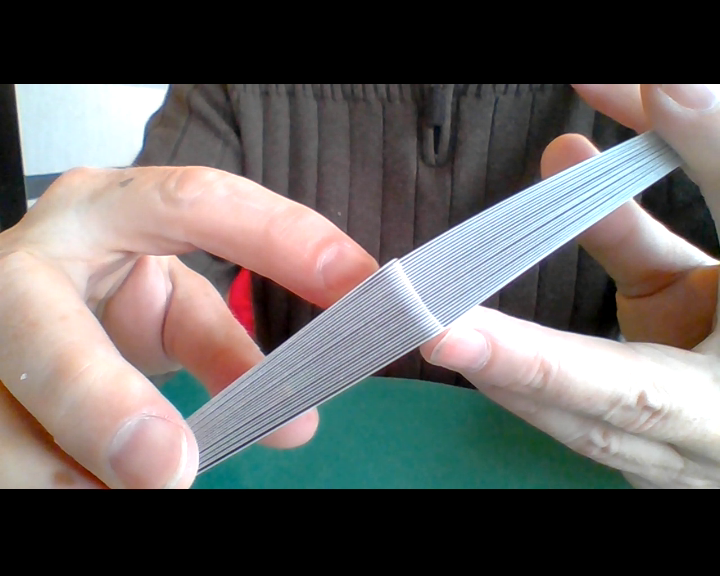
If you miss the weave it will look something like this:
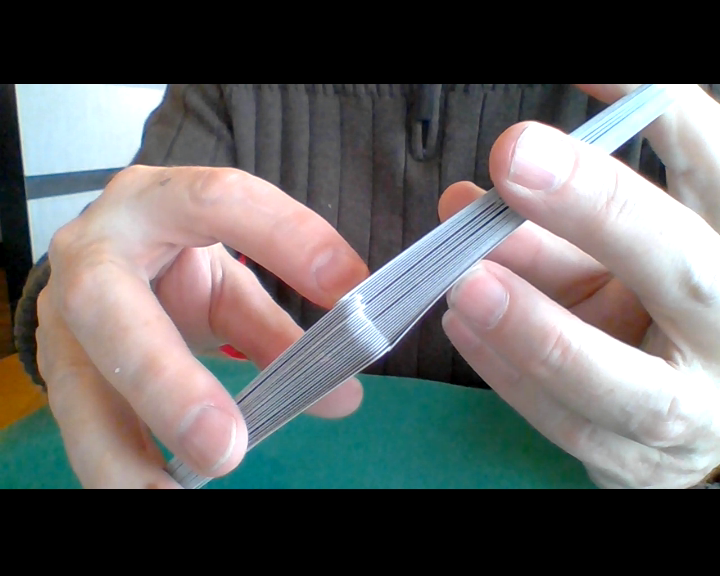
You can clearly see two places where the cards did not weave one-for-one. In addition, the left hand cards are are straddling the right hand cards, meaning a card(s) from the left hand packet is on the top and on the bottom of the woven deck. In these cases, simple pull (un-weave) the halves and start over.
Expert Card Technique and other notes
If you go back to the description of the Faro shuffle in Hugard and Braue’s book “Expert Card Technique” (chapter 16, page 127) you will find that they teach a tabled Faro shuffle with the weave from the top. The same principles apply as with the in-the-hands Faro shuffle. One aspect of their instructions that is confusing is that they say to squeeze the cards so that the bridge lengthwise. I don’t find this necessary.
I find a tabled Faro Shuffle much harder to do. Partly because it is harder to estimate a perfect cut at 26. Also you can’t see the edges of the cards as they weave. When I do a tabled faro I usually will do a bottom up weave.
Expert Card Technique also discusses some of the interesting math associated with the shuffle. Anyone performing Faro Shuffles know that eight out shuffles returns the deck to its original state. Hugard and Braue point out the 18th and 35th cards change locations with each out shuffle, the 18th moves to the 35th and vice versa.
Another interesting feature of the Faro shuffle is its relationship to binary notation. This is a discovery of Alex Elmsley. If you abbreviate In and Out shuffles with an “I” and an “O” then to move the top card to position N in a deck is done by subtracting 1 from N and converting the result to binary notation. The pattern of one and zeros indicates the number of in and out shuffles needed. For example, to move the top card to position 8th in the deck, subtract 1 to get 7, convert to binary: 111 and the answer is three In shuffles will move the card to position 8th from the top.
| Destination | N-1 | In and Out Faros |
|---|---|---|
| 1 | 0 | 0 |
| 2 | 1 | 1 |
| 3 | 2 | 10 |
| 4 | 3 | 11 |
| 5 | 4 | 100 |
| 6 | 5 | 101 |
| 7 | 6 | 110 |
| 8 | 7 | 111 |
| 9 | 8 | 1000 |
| 10 | 9 | 1001 |
| 11 | 10 | 1010 |
| 12 | 11 | 1011 |
| 13 | 12 | 1100 |
| 14 | 13 | 1101 |
| 15 | 14 | 1110 |
| 16 | 15 | 1111 |
| 17 | 16 | 10000 |
| 18 | 17 | 10001 |
| 19 | 18 | 10010 |
| 20 | 19 | 10011 |
| 21 | 20 | 10100 |
| 22 | 21 | 10101 |
| 23 | 22 | 10110 |
| 24 | 23 | 10111 |
| 25 | 24 | 11000 |
| 26 | 25 | 11001 |
| 27 | 26 | 11010 |
| 28 | 27 | 11011 |
| 29 | 28 | 11100 |
| 30 | 29 | 11101 |
| 31 | 30 | 11110 |
| 32 | 31 | 11111 |
| 33 | 32 | 100000 |
| 34 | 33 | 100001 |
| 35 | 34 | 100010 |
| 36 | 35 | 100011 |
| 37 | 36 | 100100 |
| 38 | 37 | 100101 |
| 39 | 38 | 100110 |
| 40 | 39 | 100111 |
| 41 | 40 | 101000 |
| 42 | 41 | 101001 |
| 43 | 42 | 101010 |
| 44 | 43 | 101011 |
| 45 | 44 | 101100 |
| 46 | 45 | 101101 |
| 47 | 46 | 101110 |
| 48 | 47 | 101111 |
| 49 | 48 | 110000 |
| 50 | 49 | 110001 |
| 51 | 50 | 110010 |
| 52 | 51 | 110011 |
If you look at the table you will see to move the top card to position 26 uses the binary notation 11001. That is five shuffles. You can reduce this by first moving the top card down with either a normal riffle shuffle or a double cut. Since the first two Faro shuffles (11) represent a binary 3, and 3+1 equals 4, these shuffles move the top card to the fourth position. So if you move the top card to the fourth position with a riffle shuffle you are left with only three faro shuffles, Out, Out, and In.
You could reduce it to two Faros by looking at the first three bits, 110, which equals 6. So if you overhand shuffle or riffle shuffle adding six cards on top the the deck, then do an out shuffle followed by an in shuffle the top card will be at 26.
Referencias
For an extensive reference list relating to magic refer to the conjuring archive web site: https://www.conjuringarchive.com/list/search?keyword=faro+shuffle
To find mathematical analysis of the faro shuffle google “faro shuffle math” and you will find more than you can comprehend.
I wrote a Faro Shuffle simulator which can be useful for seeing the relationship of the cards during the shuffles. You can find it at https://robertjwallace.com///faro.
You can play the game of Faro at https://robertjwallace.com///faro-game.