
AI Coding – finding the sweet spots

I don’t think people realize what will happen with AI coding eventually. I have been playing with AI Coding for a little while and I am amazed at how well it does for certain tasks. These are simple programs that I have AI write for my personal use. I have had several Android Phone Apps created by AI that I use as a magician, for example. These apps are not intended for the general population and do not need to meet everyones needs, only mine.

Recently I found a old ASUS Nexus 7 Android tablet that I wanted to resurrect. I decided that I would use it as a controller tablet for my Home Assistant home automation system, something akin to a Kiosk mode controller. I had a brief chat with Google’s Gemini which told me that what I wanted to do was doable, but that since the device was old the code would have to be written without using the latest web tech. I suggested using the Home Assistant API and it thought that was a great idea. (I do find it annoying that AIs find all ideas to the great, even when they are not.)

Here is where I was amazed. I went into my Home Assistant and copied its configuration file. I uploaded that to Gemini and it extracted the devices I have from the file, suggested which ones it thought I should include, and then wrote the Javascript and HTML code for the app. It also gave me instructions on where to put the file within the Home Assistant server.

I uploaded the file and it worked. Now note that I could have used a third party plugin to Home Assistant that puts Home Assistant into a Kiosk mode, but I would have had to create a Home Assistant dashboard with the devices. Also, it is likely that that page would not have run on the Nexus web browser.
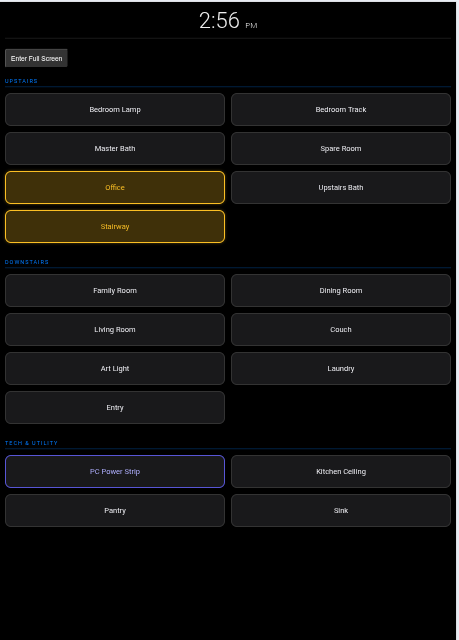
Kiosk Page to control my Home Assistant from my Nexus 7 tablet

What does this mean for the future. I still had to copy and paste the code, but we are already seeing AI agents that can take over even those tasks. I can see when users no longer open the Play Store to download an app, or search for a PC Program. Instead they will simply tell the AI Agent what they want the program or app to do and it will be created for them. If it isn’t exactly what you want, no problem, just tell the AI what to change.

Additional thoughts

So having AI build the new web page based interface I decided that I wanted it to run as an app, not has a web page via the browser. The problem with using the browser was that it opened with the browser tool bar and headers. So I asked the AI to build a Cordova app that simply showed the page, without using Chrome or Firefox.

It did this, but it was a bit harder. Not harder techically, harder in the sense it took the AI more time to get it right. The reason was that I am using very old hardware. Cordova has many dependencies and the AI had to figure out what version of each layer of technology would work. It eventually got there and I now have an app on the tablet that opens the kiosk mode directly.
SearchCipher – my latest phone app

The original Akronym effect (created by Yves Doumergue and available from Conjuring Lab) uses Wikipedia – spectators navigate through Wikipedia articles, clicking on random links and selecting words from the article titles they land on. Through letter extraction, their name is revealed. It’s a clever effect that has earned strong reviews from professional mentalists.

Continúa leyendo "SearchCipher – my latest phone app"

Ghost Card: Another Android based Magic Effect

This is another Android app the I created using Claude.ai and Cordova. I started by asking the AI for some ideas for apps. One that it suggested was a “Ghost Card” app where the spectators chosen card magically appears on an image that was just taken with your phones camera. Two hours later I had a working app. Most of that time was spent in making tweaks and enhancements to the app.

Continúa leyendo "Ghost Card: Another Android based Magic Effect"

Mind reading phone app and more

Imagine showing your spectator a deck of cards laid out in an app on your phone. There are two buttons, “Shuffle” and “Flip Cards”. You demonstrate how the buttons work. The cards are face up and you shuffle them several times. The spectator sees the cards are shuffled. You flip the cards face down and shuffle again. You set the phone down and turn away, telling the spectator to touch any of the face down cards. They do, and their selection is turned face up. You have them concentrate on that card and then you read their mind, revealing the card. You can immediately repeat the effect.

Continúa leyendo "Mind reading phone app and more"

New Android Trick App

The Future of Card Magic is Digital

You’ve just performed the perfect classic card trick: a spectator selects a card, keeps it secret, and you’re ready for the big reveal. But instead of fumbling through your deck, you pull out your phone, launch your QR code app, and hand it to them. “Scan this,” you say. “Yesterday, I had a strange feeling… that your card would be chosen.” They scan the code, open the dedicated webpage that pops up, and there it is: their chosen card, staring back at them from the screen. Forget the deck—the future of impossible prediction is now woven into the digital world.

Continúa leyendo "New Android Trick App"

Building Mobile Apps with AI: My Cordova Development Journey

Over the past few weeks, I’ve been using Claude (an AI assistant from Anthropic) to help me build several mobile applications using Apache Cordova. The experience has been eye-opening – both for what worked remarkably well and what proved frustratingly difficult. If you’re considering using AI to help with mobile development, here’s what I learned.

Continúa leyendo "Building Mobile Apps with AI: My Cordova Development Journey"