
Bluff Shift, bluff center

Effect:

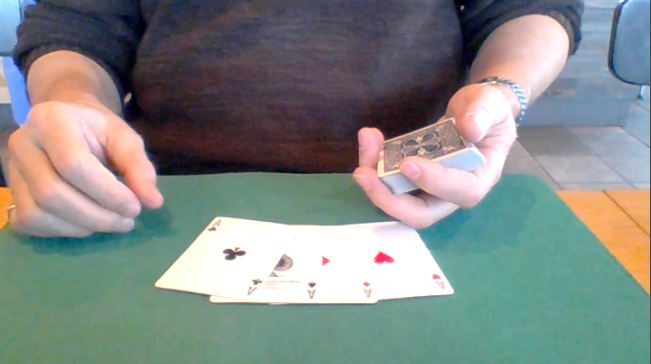
Four aces are displayed on top of the deck. They are turned face down and inserted (and left protruding) in the front of the deck in different locations. The deck is turned face up to display the aces, then turned face down and the aces are pushed flush into the deck. The deck is then cut and shuffled once. The four aces are back on top of the deck. An alternative is a faux demonstration of a center deal.

Continue reading “Bluff Shift, bluff center”
Stacking the deck

Below is one of my “Starbucks” videos of a practice session of stacking the deck. What I like to do is stack the four aces for a five handed game using different stacking techniques. In the video I stack the deck with a Zarrow shuffle, then a riffle shuffle technique, then Erdnase overhand shuffle, a milk shuffle, and an overhand shuffle from Dai Vernon.

Continue reading “Stacking the deck”

Visual Ace Production

This is something that I am playing around with, trying to find the right combination of sleights.

Effect:

Spectator shuffles the deck.  The performer shows the faces of the cards and comments on how well mixed they are.  The performer then does a couple of shuffles to further mix up the cards.

Then the performer shows the top two cards of the deck by turning them face up.  The performer then shows the bottom cards of the deck by flipping the deck face up on top the two top cards.  Then turning the deck face down, the performer waves his hand over the deck and a face up ace appears.

Continue reading “Visual Ace Production”

Ace Control notes

The following table shows the movements of the aces during the Ace Control.  The first column assigns a number to the 52 cards from the top card, 1, down to 52.  Since the aces begin out of the deck, they are numbers 49, 50, 51, and 52.  Reading the other columns from left to right show what happens as each ace is inserted into the middle of the deck and then the cuts are made.

The column labeled "First Ace" shows the ace being inserted at location 26 in the deck.  The next column, "After Cut" shows that that ace has move to location 2, etc.

Read More

Ace Control

This is my own ace control. It looks very fair, with each ace being inserted into the deck and the deck cut several times. Between each ace insertion the top and bottom cards can be shown. After inserting the aces and cutting, the deck is shuffled once and then all four aces are back on top.

The left hand column describes the cutting actions, the right hand column shows photos and adds more detail. There is a video at the bottom of this post showing the action.

Begin with the four aces face up on the table.

Photo 1.

Read More

Finding the Aces with Erdnase

This is an effect that I use to practice the Erdnase system of cull shuffling.

Effect:  The performer shuffles a deck of cards and then has the spectator shuffle them as well.  The performer then takes the deck back and ribbon spreads the deck face up on the table, remarking that the deck is now well shuffled as the spectator can see.

Picking up the deck the performer give the deck another shuffle, overhand shuffling the cards.

Then explaining how card sharps always need to find some good cards for their hand, the performer turns over the top four cards, revealing the Aces.

Read More

Aces and Dice without the Dice

This is basically the same trick as Aces and Dice but without the dice.

Effect: Have the spectator shuffle the deck. Take the deck back and turn it face up. Spread the cards to show the mixed condition. Turn the deck face down and do an overhand shuffle to further mix the cards as you explain the card cheats develop sensitive fingers that let them tell when there is a card they need for their hand.

Read More