Effect:
Performer shuffles a deck of cards twice and sets the deck down. Then displays four dice. The specatator rolls the dice to come up with four random numbers. The performer picks up the deck and shows the top and bottom cards, and then deals four piles of cards. The number of cards dealt to each pile corresponds with the number on each die. For example, if the dice showed a 4, 3, 5, and 3, then the first pile dealt would have 4 cards, the second 3, the third 5, and the fourth 3. Turning the top card of each pile reveals the four aces. The main sleight used for this is a second deal.Method:
Start with the aces in the positions from the top of the deck of 5th, 7th, 13th and 15th. The deck can be preset or the aces can be culled to the top of the deck and the cards stacked into position with two shuffles described later. Note that if the deck is preset you can perform any false shuffle that keeps the top 15 cards intact. With the aces in the correct position there are many combinations of dice rolls that let you deal out the piles to end with the aces. The trick is in the order the dice are arranged, and the use of a second deal when required. The first ace is at position 5th from the top. So if a five is rolled then it can be used to deal the first pile. But even a four can be used by using a second deal on the fourth card. Likewise if a six is rolled then a second deal on the fifth card places an ace as the last card dealt. Once the first pile is dealt, the second ace, which was at position 7th from the top to begin with will now be either on top (if the first pile has six cards), second (if the first pile has five cards), or third (if the pile has four cards.) So for the second pile the die is a little more tricky. A simple way to figure out what the first two die can be is to make sure they add up to seven. For example, a six for the first and a one for the second, or a five and two, or a four and three. In all of these cases you can easily arrive at an ace on top of each of the first two piles with only a couple of second deals. The best case of a five and two have no second deals. If the first two dice add up to seven, then after the two piles are dealt, the remaining two aces are at positions 6th and 8th from the top of the remaining deck. Below are tables showing the deals with the letter “T” for dealing a top, and the letter “S” for dealing a second.|
Two die adding to 7 |
|||||
|---|---|---|---|---|---|
|
4 |
3 |
5 |
2 |
6 |
1 |
|
T |
T |
T |
T |
T |
T |
|
T |
S |
T |
T |
T |
|
|
T |
T |
T |
T |
||
|
S |
T |
T |
|||
|
T |
S |
||||
|
T |
|||||
|
Positions of the last two aces after making the first two piles |
|||||
|
6 |
8 |
6 |
6 |
6 |
8 |
The first two dice can also add up to either a six or an eight.
|
Two die adding to 6 |
Two die adding to 8 |
||||||||
|---|---|---|---|---|---|---|---|---|---|
|
4 |
2 |
5 |
1 |
6 |
2 |
5 |
3 |
4 |
4 |
|
T |
T |
T |
S |
T |
S |
T |
T |
T |
T |
|
T |
S |
T |
T |
T |
T |
S |
T |
T |
|
|
T |
T |
T |
T |
T |
T |
T |
S |
||
|
S |
T |
T |
T |
S |
T |
||||
|
T |
S |
T |
|||||||
|
T |
|||||||||
|
Positions of the last two aces after making the first two piles |
|||||||||
|
6 |
8 |
7 |
9 |
5 |
7 |
5 |
7 |
5 |
7 |
So in the case of the first dice adding to 8, then the remaining aces are now at the 5th and 7th positions. In the case of the first two dice adding to 6, the remaining dice end up either in positions 6 and 8 (as in the case of the dice adding to 7) or, positions 7 and 9.
Case of last two aces at 6th and 8th
Now lets look at the last two dice. Since four of the above scenerios end up with the remaining aces at the 6th and 8th position lets look at that case first. To get to the 6th card you need either a 5 or a 6 spot rolled. In the case of a 6 spot, you simply deal down to the ace. The last ace is then second from the top and you can use any spot value to reach it with using seconds. If the die is a 5 spot then you deal four down and then a second. This leaves the last ace third from the top, so in that case you can use any die value except the one spot. So looking at all the cases of the third and fourth aces ending up 6th and 8th from the top here are some die combinations that work:- 4, 2, 6 and 1
- 5, 2, 5 and 2
- 5, 2, 6 and 6
- 6, 1, 5 and 3
Case of last two aces at 5th and 7th
This is identical to the conditions of the first two aces, so those solutions apply.Case of last two aces at 7th and 9th
In this case to get to the 7th card you need to have a six. But any value then can get to the ninth card with some second dealing.Tips
- I use a web-based dice roller for practicing. Check out https://www.randomlists.com/dice?sides=6&qty=4.
- Always look for two dice adding to seven first. Remember the key numbers: 5,7,13, and 15. Then as you complete a pile you should easily be able to add the number of cards dealt and compute where the next Ace will be. For example if you have already dealt a 6 pile, a 1 pile and a 6 pile, you have dealt 13 cards. The last Aced is then second from the top of the deck.
- There are only a few dice combinations with one spots, so avoid rolls with ones. There are only two rolls that have two 1s that work: 1,1,5,6 and 1,1,6,6. There are fifteen more rolls that have only one 1. All seventeen are listed below:
- ‘1156’
- ‘1166’
- ‘1255’
- ‘1256’
- ‘1266’
- ‘1345’
- ‘1346’
- ‘1355’
- ‘1356’
- ‘1366’
- ‘1445’
- ‘1446’
- ‘1456’
- ‘1466’
- ‘1556’
- ‘1566’
- ‘1666’
- The spectator rolls the dice. If you don’t get a roll that you can use, just have them roll again to show that the dice aren’t loaded.
- Remember, while the spectator rolls the dice, you put the dice in a row in the order that will work for you. All the spectator will remember is that they rolled the dice.
- The more you practice the quicker and better you will get at seeing the patterns.
- If the total of the four dice is less than 14, then the roll will not work. If you think about this you can see why. Since the last ace is at the 15th spot, you need to deal at least 14 cards to reach it.
- While it seems like there is a lot of ways to roll four dice the number is actually only 1296, but a lot of those rolls are equivalent. Think 1,2,3,4 and 2,1,4,3. They are actually the same. Looking at the possible rolls taking that into account there are only 126 ways. Of those, 80 will not work, and 46 will. So 36 percent of the time you should get a good roll.
Patter
I talk about fortune telling. How historically it has been done with either cards (tarot) or dice (runic stones, I ching, etc). Then I offer to demonstrate how both methods can be used together. After the climax of showing the four aces I tell the spectator that according to the dice and cards they are going to be very lucky.Example thought process
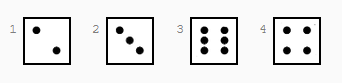 Looking at the dice above I see a seven (4 and 3). That makes the six and two work with out any seconds so I order the dice: 4, 3, 6, and 2. Dealing T, T, T, S – T, S, T, – T, T, T, T, T, T, – T,
 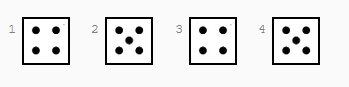 In this example I don’t have any pairs adding to seven. But I do have a five that gets me to the first ace. The second ace is two down after the first pile is dealt. So dealing the four spot next uses two cards from the bank of six cards for the third ace. So after dealing the second pile, instead of the third ace being 6th from the top, it is now 4th, which works perfectly for the four spot. Then end with the five. Order the die 5, 4, 5, 4 and deal; T, T, T, T, T, – T, S, S, T, – T, T, T, T, – T, S, S, S, T
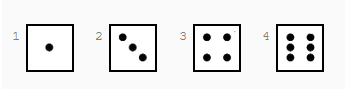 The six and one add up to seven, but the third ace would need a five or six to reach it. But the four and three also add to seven, and then the six works, and the one is dealt as a second. Order the die: 4, 3, 6, 1 and deal: T, T, T, S, – T, T, T, – T, T, T, T, T, T, – S
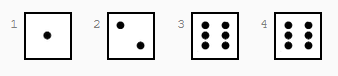 Similar to the first example. There is a seven (6 and 1). Then the 6 and 2 work automatically. So I order the dice: 6, 1, 6, 2. Dealing T, T, T, T, S, T, – T, – T, T, T, T, T, T, – T, T
Setting the aces
One method I use is to have the spectator shuffle the deck. When done I take the deck and spread it face up to “show” that the cards are well mixed. I use a spread cull technique to get the aces to the top of the deck. I then use a table riffle shuffle, holding back the four aces with one hand and four indifferent cards with the other. I drop two aces, then two indifferent cards, then the last two aces, then the last two indifferent cards. I then do one out faro shuffle. (Sometimes I do an in faro shuffle and take a break under the cards added to the top. Then double cut those cards to the bottom). The aces are now in position. Another method is to get the aces to the bottom of the deck and use a milk stack. With the aces on the bottom: run one card from the top, milking one ace from the bottom. Repeat once more. Run four cards from the top. Run one card from the top, milking one ace from the bottom. Repeat once more. Run nine cards and injog the tenth. Shuffle off the rest of the deck. Undercut at the injog and shuffle off six cards and then throw the rest on top. The deck is now stacked.Aside: Some of the bad rolls can be changed to good ones by simply adding or removing one or two cards from the top of the deck. See my post on the python program I wrote to see the list of good and bad rolls. As an example, 4, 4, 4, 5 is a bad roll. But by slip cutting the top card to the middle of the deck it becomes a good roll by dealing: T, T, T, T, – T, S, S, T, – T, T, T, T, – T, S, S, S, S
Aside: Note that you can do the trick without dice. Patter about how sensitive your fingers are. Do the shuffles setting the aces and then start to deal the cards face down. As you come to each ace, set it aside face down. The last ace can be held back by dealing seconds. So the deals would be deal five cards and set the fifth aside, deal two more setting the seventh aside, then deal six more, then deal as many as you want holding back the last ace.
Then turn over the four aces to show them.