
Introducción
The first exposition of the principles of card magic was published in 1769 by the French writer Guyot, and he it was who first laid down the dictum that mastery of the pass is the first requisite of the art of conjuring with cards. [Note: Guyot’s work “Nouvelles récréations physiques et mathématiques” was one of the earliest systematic treatments of conjuring principles and established many foundational concepts still used today – RJW] His actual words were: “Before risking an attempt at these kinds of Recreations, you must know how to make the pass.”
All succeeding French writers on the subject followed his lead and insisted that the pass is the first essential. Professor Hoffmann, whose book Modern Magic, published in 1876, was the first scientific treatise on magic in the English language, took most of his material from the French authors and followed their example in this respect. [Note: Professor Louis Hoffmann (Angelo John Lewis) revolutionized English-language magic literature with “Modern Magic,” which became the standard reference work for generations of magicians – RJW] He described the pass as “the very backbone of card conjuring,” and for years this statement was accepted as gospel by all our other writers, who reiterated without exception that, “without the pass, card magic is impossible.”
The pass is a very difficult sleight to master, and this insistence on its indispensability makes it easy to understand why the would-be card conjurers of the last century, after a prolonged and vain struggle with the intricacies of this sleight, finally decided that conjuring with cards was not for them and turned to some easier hobby.
After all, the principal use of the pass is to bring a chosen card from the middle of the pack to the top, or vice versa; but it was not until the turn of the century that card conjurers freed themselves of this inhibition and devised easier methods of attaining the same objective. [Note: This refers to the late 1800s/early 1900s when magicians like Erdnase, Leipzig, and others began developing alternative methods to achieve the same effects without relying solely on the classical pass – RJW]
We have shown in the preceding pages that the pass is not absolutely essential to card conjuring and that any trick can be performed without using it. Any intelligent person who really has the urge to perform good tricks with cards, and to do just that in the shortest possible time and with the simplest possible methods, has been shown how it can be done. The methods which have been given are simple, but always in conjuring the simplest methods are the most effective. By mastering the simple, natural ways of making all necessary moves which we have given you, you will have made great progress in a surprisingly short time.
Although we have relegated the pass to the role of a subsidiary sleight, we do not wish you to think that it is unimportant. When it is done well it is the most important sleight in card magic; but, because it is so difficult to master, it should be the last sleight which the novice should be called upon to learn. We can think of no good reason why you should not be performing good card magic in the months it will take you to learn to do the pass well; we do not want you to wait until you have learned this difficult sleight.
And if you never do learn this sleight you still will be able to perform mystifying, amusing, and deceptive tricks of card magic by using the other methods which we have given you; these you will continue to use in any case, even when you have mastered the pass.
The Pass
The Grip:
- Hold the pack, back upwards, in the left hand as for dealing, but with the thumb flat against the left edge of the cards (Fig. 81).
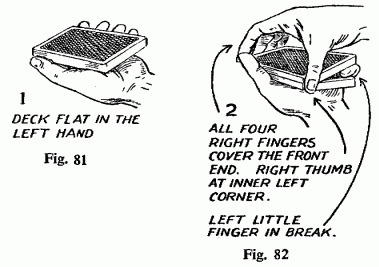
- Insert the little finger tip between the two portions of the pack to be transposed.
- Place the right hand over the pack, the fingers at the outer end and the thumb at the inner end (Fig. 82).
Left-Hand Action:
- Grip the upper packet firmly, by pressing down upon it with the first phalanx of the left ring finger, thus gripping it firmly between that finger and the little finger. Press the first phalanges of the index and middle fingers on the top of the pack. [Note: A phalanx refers to the individual segments of the fingers; the first phalanx is the segment closest to the fingertip – RJW]
- Straighten the left hand so that the fingers, between the first and second phalanges, are parallel with the back of the left hand. The upper packet will be carried to the right between the left little and ring fingers, which continue to grip it firmly.
Right-Hand Action:
- Now press upwards against the outer end of the lower portion with the right middle finger, which bends inwards to exert that pressure upwards. This pivots the lower portion between the middle finger and the thumb of the right hand, slanting it upwards to the right, until it moves above the other packet (Fig. 83). Note particularly that the left thumb remains pressing against the left edge of the packet.
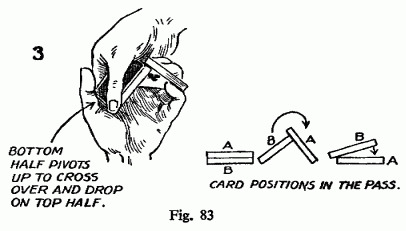
- Close the left fingers into the palm, carrying the upper packet below the other, where it rests on the left palm.
- Close the packet originally at the bottom on top of the other portion, and square the pack. Do not extend the left forefinger in the action. This is a very common and serious fault. [Note: The extended forefinger is a telltale sign that alerts spectators to the sleight being performed – RJW]
The classical pass just described requires a cover of some sort, and in general the advice given is never to do it immediately after a card has been returned to the deck or while the eyes of the spectators are fixed on the performer’s hands. There are certain covers, however, which allow one to do just that; since they are known to very few, we shall set them forth here. The first and one of the best follows.
Riffle Pass
- A card having been returned to the deck, preferably somewhere about the middle, and a break having been secured above it with the little finger, square the cards so that the outer end of the deck, visible to the spectators, is perfectly regular.
- Riffle the outer ends of the cards with the right middle finger, the hands moving slightly upwards and separating in the action. This is the feint.
- Bring the right hand over the deck to repeat the riffle; the moment the hands begin to move upwards, make the pass and immediately riffle the ends of the original lower packet, which is still held between the right middle finger and thumb, the cards falling upon the original upper packet, now at the bottom.
- Finally riffle the whole deck and square up.
Smoothly done, the transfer of the upper packet to the bottom appears to be a part of the riffle.
Spread Pass
Make the pass in the usual way, but, as soon as the upper part of the deck has been transferred to the bottom, spread the cards of that packet with the left thumb on the fingers of the left hand, stretched out flat for their support. At the same time make a short quick remark, such as, “You see your card remains in the middle of the deck!” Close the spread smartly and execute an overhand shuffle, controlling the card as may be necessary. [Note: This combines physical misdirection (the spread) with verbal misdirection (the comment) to mask the sleight. In all passes misdirection is critical. Never look at your hands when performing the pass. Look at the spectator and ask them something. This draws their gaze to your face. – RJW]
A slight swing of the hands from left to right will help to make it appear that the spreading of the cards is all that has taken place.
Spring Pass
The idea behind this cover is the same as that in the riffle pass-the distraction of the attention of the spectators by a secondary artifice.
- With the pack held flat in the left hand, the left little finger holding a break above the chosen card, with your right hand lift the greater part of the cards above the break between the tips of the thumb and middle finger at the ends and spring them on to the cards in the left hand.
- Square the deck and repeat the same action.
- Square the cards again, make the pass, and immediately lift the packet now held between the right thumb and middle finger and spring these cards on to the cards in the left hand.
Correctly executed, the pass is quite invisible. The spectators have become used to the fall of the cards into the left hand, and this manoeuvre covers the actual movement of the pass. [Note: This demonstrates the principle of “conditioning” the audience – establishing a pattern of action that makes the final deceptive action appear to be just another repetition of the established pattern – RJW]