
When used in moderation and properly done this sleight is one of the most useful and deceptive of modern card sleights. Unfortunately many cardmen do it badly and far too often. We would caution the student first to learn to execute the sleight perfectly and then to use it sparingly and discreetly. [Note: This advice reflects the authors’ emphasis on quality over quantity in magic performance, a principle that remains valid today. Perhaps the best advice is to strive to be natural. – RJW]
As the name implies, the sleight consists of lifting two cards as one, turning them over on the deck, and then turning them face downwards again. The moves are as follows:
- Hold the deck face downwards in the left hand, practically in the position for dealing but with the left thumb extended against the left side. With the right hand square the ends, and at the same time wedge the pack slightly by pressing back with the tips of the last three fingers on the outer edge, the tip of the index finger resting on the back near the outer end.
- With the tip of the right thumb lift the inner end of the top card and then the inner end of the second card about a quarter of an inch (Fig. 79).
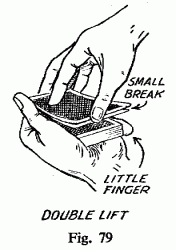
The wedging of the pack enables you to do this with ease and certainty. Press the tip of the left little finger against the side of the second card to hold the break thus made. Do not insert the tip of the finger into the break. [Note: this is known as the “get ready”, it is the action that prepares you for the double lift. It is crucial that it be done with misdirection. A good technique is to not lift the cards, but rather to drop rear of the deck slightly – RJW] - Make another squaring motion with the right hand, and then remove it to make some gesture appropriate to your patter.
- To lift the two cards as one, turn your right hand palm upwards and seize the inner right corners between the tips of the thumb above and the index and middle fingers below. Turn the hand over to the left and lay the two cards face upwards on the deck so that the lower ends protrude inwards about half an inch (Fig. 80).
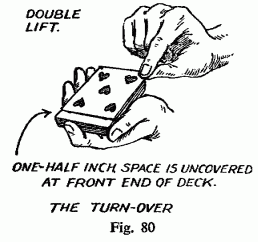
Move the right hand away toward the right, running the tip of the thumb along the ends of the two cards. This is done to make certain that the ends of the two cards will be perfectly aligned. The pressure of the left fingers on the cards, forcing them against the ball of the thumb, will ensure the sides being flush. - The second card having thus been shown, turn the two cards face downwards again as follows: With the right hand palm upwards, seize the index corner, turn the two cards face down, and lay them flush on the pack.
Done properly, the sleight is a very easy one. The two cards must be made ready and the hands separated before the lift and turnover is made. Too often the move is made immediately after fumbling in getting the two cards separated at the inner ends. To attain an easy and natural action in performing the sleight, first turn a single card in the manner described, and then turn two cards as one, copying the action closely. [Note: this advice is true for all slights that simulate a real action. They need to look like the real action as much as possible – RJW]
Double-Lift Glimpse
The double lift affords a subtle method of glimpsing a chosen card when it is on the top of the pack. Ostensibly, to show that the card is not at the top, make a double lift, showing the second card and naming it. Replace the two cards, then show the bottom card and call its name. Turn the pack face downwards and lift the top card, holding it so that only you can see its face, and again name the second card. Note what it really is and replace it. Miscalling a card can often be used to good advantage.
Double-Lift Card Reverses
One of the most effective climaxes for a quick trick is that in which a chosen card is found face upwards when the deck is spread face downwards on the table.
The following methods of secretly reversing a card make use of the double lift:
A. Top Card Reversal
In this method the top card is found reversed in the centre of the pack.
- Hold the pack face downwards in the left hand, as for dealing, with the chosen card at the top.
- Double-lift the two cards at the top and turn them over as one card, placing them face upwards on the pack. Square the pack and call attention to the card face upwards at the top.
- Turn the left hand palm downwards, thus turning the pack face upwards. Shift the grip of the left hand, so that it holds the pack as for the glide. Tap the face card and call attention to it.
- Draw off the top card, now the lowermost card, which was originally second from the top. It will be face downwards. Turn it face upwards, mention its name again as if refreshing your memory, and thrust it into the centre of the pack.
- Make a single complete cut with the face-up pack, and the chosen card is reversed at the centre.
Note that the chosen card may be glimpsed by tilting the pack a little toward yourself in making the cut.
In this and the next two methods, cards with a white border should be used.
B. Second Card Reversal
In this method the chosen card is second from the top.
- Hold the pack face downwards in the left hand, as for dealing. Turn the top card face upwards, and square it on the deck. As you do this, secretly push the second card a little off the pack to the right, and slip the tip of the left little finger under it. Call attention to the card face upwards at the top.
- Grasp the two cards at the ends, near the right corners, between the right thumb and middle finger. The break under the two cards held by the little finger makes this easy. Slide them to the right as one card, until their left side rests on the left finger tips.
- Drop the left thumb under the pack and flip this over to the right so that it falls face upwards upon the two cards held by the right hand. Call attention to the card at the face of the pack.
- Square the pack and make one complete cut, placing the chosen card at the centre in reversed position.
C. Second Card Reversal
The chosen card is second from the top.
- Hold the pack face downwards in the left hand, as for dealing. Turn the top card face upwards and square it on the deck. at the same time secretly pushing the second card to the right with the left thumb and slipping the left little finger tip under it.
- Grasp the two cards above the little finger tip at the ends, near the right corners, between the right thumb and middle finger. Slide them to the right so that their left edges rest on the left finger tips.
- Push the third card, which is face downwards, off the pack with the left thumb. Flip it face upwards on the pack with the two cards held by the right hand. Calling attention to it, push it off the pack with the left thumb and take it squarely under the two held in the right hand. This hand now holds three cards, the middle of which is face downwards, although the audience believes that only two cards are held.
- Replace these cards on the pack, flipping them face downwards. The chosen card is face upwards below the top card. Make one complete cut to carry it to the centre of the pack.
This method differs from the others mainly in that the pack is not turned over.