
The Reverses
The revelation of a card face upwards in a face-down deck is a favourite feat with the card conjurer, and a few of these tricks have already been explained. A card reversed in the pack is also used as a secret artifice which makes possible many puzzling feats.
There is one cardinal condition that applies to all the tricks in which a card is reversed in the pack–the fact that the principle must never be used with cards having an overall back pattern. The reason is obvious, for with such decks the slightest spreading of the cards reveals part of the white face of the reversed card.
[Note: Modern cards like Bicycle Standards, Bee Cards, and Tally-Ho cards work excellently for reverse effects due to their white borders. Avoid borderless cards like some modern artistic decks, and be especially careful with cards that have busy, edge-to-edge back designs.]
Cards with a white margin on the back allow for a spread of about three-sixteenths of an inch between cards without exposing any part of the back patterns. In fact, with a card face upwards in the deck, the cards can be spread in a fairly large fan without any risk of exposure.
We have already discussed methods of reversing a chosen card under the Double Lift. Before explaining the best feats in which reversed cards play the leading role, other ways of secretly reversing a card or cards at the top or bottom of the deck must be considered.
Primer método
One of the best and easiest ways of reversing a single card either at the top or the bottom of the deck, is this:
- Hold the deck in the left hand, turn half left, and at the same time let the left hand drop to the side.
- Push off the top card with the left thumb so that its side strikes against the side of your leg (Fig. 97). Move the hand downwards, the thumb still pressing on the back of the card which will make a half revolution. With the fingers press it flush with the other cards and replace the thumb on the top of the pack (Figs. 98, 99).
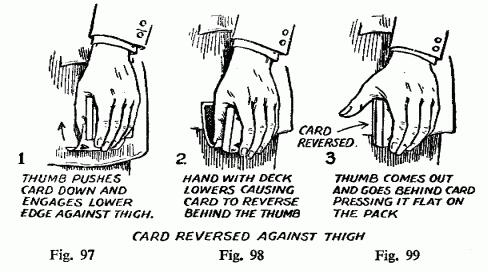
[Note: This “leg reverse” is still taught today and remains one of the most natural-looking methods. The misdirection of turning your body and lowering your hand makes this virtually undetectable when properly executed. Practice the timing so the reversal happens during natural movement.]
The whole action takes but a second, and the fact that the left hand is out of sight momentarily will never be noticed.
Segundo método
- Under cover of squaring the pack, palm the top card.
- Keep the grip of the first phalanges of the right thumb and forefinger on the right-hand corners of the deck, and turn the hand to a vertical position.
- Extend the left fingers and insert their tips under the lower side of the palmed card. Flex them and thus draw the card flush against the bottom of the deck, back downwards.
[Note: This method requires solid palming technique. Modern magicians might prefer the “Gambler’s Cop” or “Tenkai Palm” for the initial palming phase, as these can be more secure than the classic palm described here.]
The action is masked by the back of the right hand, which then squares the cards again and is removed.
Tercer método
This method makes use of the artifice already mentioned in Throughth and Consequences.
- Hold the pack in the left hand, and secure a break under the top card with the left little finger, conversing as you do so.
- Withdraw the bottom card and place it face upwards at the top. Give the impression that you are toying with the cards.
- With the right thumb and middle finger at the ends, lift the two top cards, as one, about an inch above the pack. Drop the left thumb under the pack and turn it face upwards on the left palm.
- Place the two cards held by the right hand on the face of the pack. Turn the pack face downwards, withdraw the bottom card, and thrust it into the centre of the pack.
The card at the bottom is now face upwards.
Cuarto método
This method may be used to reverse a chosen card in the centre of the pack, or to reverse any card at the bottom.
- Let us say that you have a chosen card at the top of the pack and wish to reveal it reversed at the centre. Hold the pack face downwards in your left hand. Place the right hand over it, thumb and fingers at the ends, and lift the inner end of the top card, holding a break under it by pressing inwards with the ball of the thumb.
- Cut off the top half of the pack with the right hand, still holding the break with the thumb.
- Drop the left thumb under the packet remaining in that hand, flip it face upwards, and place it on top of those held in the right hand.
- Place the left hand under the deck, and drop into it all the cards below the break held by the right thumb. Move the left hand away, drop the thumb under this packet and flip it over, face upwards, on the palm.
- You now hold a packet face upwards in each hand. Ask if either of the face cards is the chosen card. Receiving a denial, place the left-hand packet under that in your right hand, and square the pack.
- Ribbon spread the cards on the table and show the reversed card.
To reverse a card at the bottom for use in a reversed-pack trick: Hold the pack face upwards and follow the above through step No. 4. Place the left-hand packet upon those held by the right hand. Spread the cards from hand to hand, showing the faces of about three-fourths of the pack but preventing the lowest cards from spreading. Do not explain why you do this. Your reason is that you want everyone to notice that the cards all face in the same direction.
Reversed Location
It is a wise magician who varies his methods for obtaining his secret objectives, and it is a still wiser magician who sets apart certain methods for certain objectives for use in set tricks. For example, it is not good policy to use the same method for controlling a card twice in one routine. By allocating a certain method to a certain trick and always using that same method in that trick, not only is there less chance of the onlookers detecting your secret operations but your work will be so much the easier and smoother for you than if you made up your mind on the spur of the moment as to which method you would use.
[Note: This advice is still golden in modern magic. Consistency in method allocation is what separates professional performers from hobbyists. Many contemporary magicians create “method matrices” to track which techniques they use in different routines.]
The location by means of a reversed card is excellent for use as a variation of method, but it should not be used more than once in the same routine. The action is simplicity itself:
- Secretly reverse the bottom card. There is no need to glimpse it first.
- A card having been chosen and noted by a spectator, and the cards having been shuffled by you while retaining the reversed card at the bottom, use the key undercut method to place the reversed card above the spectator’s card when it is replaced in the pack. Slope the packets downwards so that the reversed card cannot be seen.
- Square the pack very openly, and the onlookers must be convinced that the chosen card is lost, buried among the other cards.
- To obtain control of the chosen card, turn half left and begin an overhand shuffle. As the middle of the deck is reached, run the cards singly until you see the reversed card, which will be facing you. Immediately thumb it off the deck, letting it fall to the floor. Stop the shuffle, drop the cards in your right hand on top of those in your left hand; apologizing for your clumsiness, stoop and pick up the fallen card. Push this card into the deck and you have the chosen card at your disposal on the top of the deck.
[Note: The “accidental” drop is a classic piece of acting that sells the illusion. Modern performers should practice this “mistake” until it looks genuinely clumsy. The chosen card ends up on top because it was directly below the reversed locator card.]
In connection with this affected clumsiness: There are two classes of card conjurers. One class takes every opportunity of parading dexterity by using flashy flourishes and showy shuffles throughout their performance, whereas the other class handles the cards just as any card player would–indeed, sometimes affecting a little clumsiness by dropping a card or the like. In the first case the reaction of the onlookers is that they are not surprised by the results of the tricks, since the “quickness” of the performer’s hands has literally been thrown at them. His work is dismissed with the remark, “He’s clever with his hands,” and forgotten almost at once. In the second case, when the spectators see the cards handled with perfect fairness and without sleight-of-hand, as they think, then the results simply seem to happen of their own accord. The magician’s feats thereafter make a lasting impression on the minds of the onlookers and will be seen by them with pleasure over and over again.
[Note: This philosophical distinction remains relevant today. Modern mentalists and “gambling demonstration” performers particularly embrace the “imperfect” handling style. The key is making your skill invisible rather than obvious. As Dai Vernon later said, “Be natural – magic should look like magic, not like a display of skill.”]