UNDER this general heading we shall describe several of the best methods known for secretly exchanging one or several cards separated from the pack, for others in the pack or held in the other hand. [link name=change1]
El cambio superior
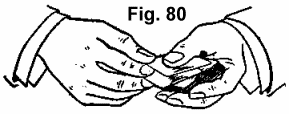
HOLD the deck in the left hand crosswise, face down, the thumb resting across the top. Hold the card to be exchanged in the right hand between the thumb and first fingertips, thumb on top finger under. Now the hands are brought together for an instant by an easy swing, both hands moving in the same general direction but one hand faster than the other. As they meet the left thumb pushes the top card slightly over the side, the right hand places its card on top and clips the protruding card between the tips of the first and second fingers, carrying it off (see Fig. 80), the left thumb retaining the now top card and sliding it back into position on the deck. In theory it seems that this action will be very easily noticed. In practice, if cleverly performed, it is almost impossible to detect. The general movement or swing of the hands is not stopped when the exchange is made but continued until they are separated again by some little distance, and the swing should be taken naturally, with some ulterior motive, such as playing the card on the table or giving it to some one to hold. A slight turn of the person may bring the hands easily together. The swing may be made in any direction, in or out, up or down, to the right or left, the one hand following or passing the other, but in no case stopping until well separated again.[link name=change2]
El cambio de fondo
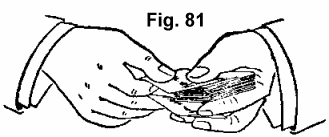
EN ESTE proceso la acción es muy similar, la diferencia es que la carta de la mano derecha se pasa a la parte inferior de la baraja, y la mano derecha se lleva la carta superior como antes.
Hold the right hand card between the thumb and first and second fingertips, first finger on top. Hold the deck with the thumb and first finger, dropping the other fingers slightly to receive the right-hand card, drawing it back under the deck as the hands separate. The top card is pushed over as before and carried off by the right thumb and first finger. (See Fig. 81.) The swing of the hands is made in the same manner. The only difficulty in this change is getting the card fairly back under the deck with the left fingers.[link name=change3]
El cambio de palma
En este proceso se emplea un subterfugio completamente diferente, y es probablemente el más ingenioso jamás ideado para este propósito.
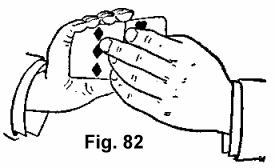
Las dos cartas que se van a intercambiar se sostienen en la mano derecha por los extremos, entre las yemas de los dedos índice y anular, y se mantienen juntas, de modo que al mostrarlas a los presentes parezcan una sola. La mano derecha se coloca con la palma hacia abajo y la izquierda aparentemente toma la carta expuesta, colocándola sobre la mesa, pero en realidad toma la segunda carta, dejando la otra empalmada en la mano derecha. Esto se hace agarrando ambas cartas entre el pulgar, el índice y el anular izquierdos, extrayendo la superior con el pulgar y presionando la inferior contra la palma derecha con los dedos izquierdos mientras se extrae la superior. (Véase la Fig. 82.)
This change is one of the simplest and easiest feats in the whole range of card slights, and yet one of the most useful and undetectable. The action should be performed in about the same time and manner that would ordinarily be taken in transferring a card from one hand to the other.[link name=change4]
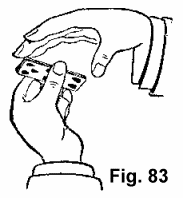
Este método puede emplearse para intercambiar una o varias cartas. Las cartas a intercambiar se colocan en un paquete sobre la mesa, boca arriba. Las demás cartas se colocan boca abajo en la mano izquierda. La mano izquierda toma el paquete sobre la mesa por los lados, entre el pulgar y las yemas de los dedos índice y anular, y lo transfiere a la mano derecha. Al girar la mano izquierda con la palma hacia arriba, la mano derecha empalma el paquete recién recogido y lo agarra por los lados en la palma izquierda, llevándolo lenta y abiertamente, con la mano izquierda vacía. (Véase la Fig. 83.)
Mientras la mano derecha palmea las cartas superiores, el primer dedo izquierdo se curva debajo de las cartas palmeadas, doblándolas hacia arriba, lo que permite que la mano derecha las agarre más fácilmente y también elimina de manera efectiva la ondulación o curvatura que pueda haberse producido al estar tan juntas en las palmas.
La única característica objetable de este cambio es que la mano derecha lleva el paquete por los lados, mientras que se podría haber notado que el paquete que primero se vio fue agarrado por los extremos. Pero este es un cambio espléndido para muchos propósitos.