
Off Agin, On Agin, Finnegin!
When the student has progressed to the point of making the transposition of the two packets fairly smoothly, the following feat will afford excellent practice:
A spectator shuffles the deck, which is then placed on the magician’s left hand. The magician cuts at any point indicated by the spectator, and the spectator removes the top card of the lower packet, notes what it is, and replaces it. By simply tapping the back of the card with the packet he holds, the magician causes the noted card to vanish and the spectator verifies the fact by examining the packet. The cards are replaced on the magician’s left hand and he taps it once more making the missing card reappear.
- Have a spectator shuffle the pack and then place it face downwards on your left hand.
- Have him indicate the point he wishes you to cut at, and lift off the cut, taking the cards between your right thumb and middle fingers. Invite him to lift off the top card of the remainder, note it, and replace it.
- Announce that by merely tapping the back of that card with the other packet you will make it vanish. Strike downwards with your right hand, so that the packet it holds will hit the top card of the left-hand packet near the edge of its right-hand side, and count “One!”
- Repeat the blow, but this time press the tips of the left fingers against the top card of the packet in the right hand and backslip the card on to the lower packet as the right hand moves smartly upwards. [Note: The “backslip” is a technique where a card is secretly transferred from one packet to another during an apparently innocent action – RJW] Thus the backslipped card is instantly and imperceptibly folded on to the back of the top card of the lower packet, the noted card. Count “Two!” and rapidly repeat the blow with your right hand, counting “Three! Off agin, Finnegin!”
- “Would you believe it,” you say, “your Finnegin card has vanished. Look!” The spectator removes the card on the top of your left-hand packet; the moment his eyes travel to its face, make the pass, but retain your grip of the lower packet with your right thumb and forefinger and carry it away, leaving the original top half of the deck lying on your left hand. All eyes will be on the card the spectator removes, and by the time they are looking at your hands you have the chosen card snugly on top of the packet in your right hand.
- “Your Finnegin card has vanished completely, as you can see.” Holding the packet upright, spread the top cards with your left thumb; or you may allow the spectator to take the packet and run through the cards.
- Square the packet on your left hand as before. Repeat exactly the same actions as in steps Nos. 3 and 4, counting and saying, “On agin, Finnegin!” Have the card named and have the spectator turn it face upwards himself.
Note that, when a spectator removes the added card, your hands should be close together, but, immediately the pass is made, move the right hand away a foot or more.
Kangaroo Card
Magicians refer to tricks that are quickly performed and have a strong element of novelty as “quick tricks.” Here is such a feat which can be performed anywhere that a man’s felt hat is available: [Note: In the era this was written (1940s-50s), felt hats were common men’s accessories, making this a practical impromptu trick for social situations – RJW]
- Have a card selected and returned to the deck, forming a break above it as described under the spread and break.
- Ask, “Who has a felt hat?” at the same time riffling the cards; then make the riffle pass, immediately afterwards executing an overhand shuffle and retaining the chosen card at the top of the pack.
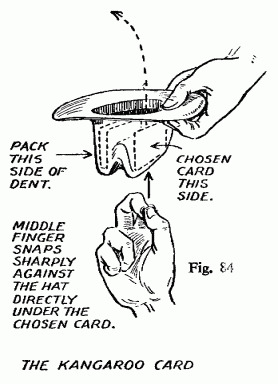
- Take the hat proffered to you. If it does not have a lengthwise crease in the crown, put one in it. Place the pack in the hat and, the moment your hand is out of sight of the spectators, push the top card into the pocket at one side of the crease and drop the pack into the pocket on the other side (Fig. 84). [Note: The crease in felt hats creates natural pockets that can conceal objects – this is an example of using everyday objects as magical apparatus – RJW]
- Ask a spectator to assist you, and have him hold the hat by the brim above the level of his eyes.
- “I call this the kangaroo card trick,” you explain, “because some of the cards jump like kangaroos.” Snap the crown of the hat with your index finger at the side which contains the chosen card (Fig. 84), making it fly up out of the hat very much like a startled kangaroo.
Righting a Wrong
This is one of those feats–so dear to the hearts of all audiences, and all magicians–in which the mystifier apparently himself becomes the mystified. He fails but in the end turns the tables in striking fashion. Nothing pleases an audience more than to catch the infallible wizard in an apparent failure. They enjoy his discomfiture for the moment, then are amazed and intrigued when he emerges triumphant. [Note: This describes the “sucker trick” principle – deliberately appearing to fail to make the final success more dramatic and satisfying – RJW]
- Have the pack shuffled, take it back, and have any card removed and noted.
- Have the card replaced and pass it to the top.
- Shuffle overhand, running seven cards above the chosen card, which becomes the eighth card from the top. [Note: “Running” cards in an overhand shuffle means deliberately placing a specific number of individual cards in a controlled sequence – RJW]
- Invite the spectator to name his card, which let us say is the ace of hearts, and instantly say, “Eight cards down!”
- Deal seven cards and prepare for a double lift, as you say, “Will you name your card again?” Turn over the two cards and show an indifferent card, which let us call the nine of clubs.
- Appear disconcerted by your failure, and turn the two cards face downwards as one. Remove the top card–the spectator’s ace of hearts–and toss it face downwards on the table to one side. “Let’s get rid of that nine of clubs,” you say grimly. “Don’t worry. I’ll find your card, if it takes all night.”
- Shuffle overhand, running seven cards above the top card as in step No. 3. The nine of clubs, which is supposed by the audience to be on the table, is now eighth from the top.
- Weigh the cards in your hand, as if making a calculation, and say in a puzzled tone, “That’s very curious. I still get a vibration of eight. Perhaps your card is at eight this time.”
- Deal seven cards and say, “This card could be any card-except, of course, the nine of clubs, which is on the table–but my vibrations tell me that it is your card.”
- Turn the eighth card and show that it is the nine of clubs. “Curiouser and curiouser!” you say. “This can’t be the nine of clubs. I put it on the table. Unless…!” Turn over the table card and show that it is the spectator’s ace of hearts.
Blindfolded Pack
Matter through matter has been a favourite subject for the stage illusionist. The same effect is had in this trick employing a pack of playing cards and a borrowed handkerchief. It was an especial favourite with the late Nate Leipzig. [Note: Nate Leipzig (1873-1939) was considered one of the finest close-up magicians of his era, known for his sophisticated sleight-of-hand and elegant presentation style – RJW]
Preparation. Secure a small quantity of diachylon (lead plaster) from your chemist. If he does not have it in stock he can secure it for you. [Note: Diachylon was a lead-based adhesive plaster commonly available at pharmacies in the early-to-mid 20th century. Modern performers would substitute this with magician’s wax or similar adhesive – RJW] Work a small pellet of the lead plaster until it is tacky, and affix it to one of the buttons of your left sleeve, where it is readily accessible. You will also need an opaque linen handkerchief.
Procedure. The steps are as follows:
- Take a shuffled pack; have a card removed and noted by all. Have it replaced in the pack and secure a left little finger break above it as described under the spread and break. Glance about you and ask for the loan of a handkerchief. Make the pass, bringing the chosen card to the top as you advance to accept a proffered handkerchief. If it does not appear to be opaque, say, “On second thought, I’ll use my own,” and remove it from your pocket.
- Hold the pack in your left hand and draw back the left sleeve a little with the right hand, grasping it at the wrist and securing the pellet of wax on the right second finger. As you do this say, “Let’s find a good place to do this trick. The floor is probably best.” If it is not desirable to sit on the floor, move toward a nearby table. In either case, affix the wax to the back of a chosen card near the middle.
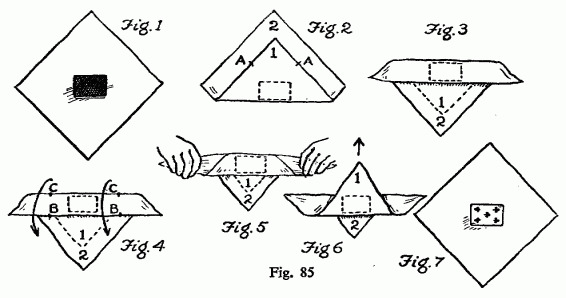
- Let us say that you sit cross-legged on the floor. Still holding the pack in your left hand, show the handkerchief on both sides. Drape it over the pack and in arranging it press down on the wax through the cloth, which will make the card adhere firmly to the fabric. Place the pack on the floor before you (as shown in Fig. 85-1), with the handkerchief centered over the pack. Corner No. 1 is nearest you.
- Fold corner No. 1 toward corner No. 2. As you do this and the following arrangement, you say, “I used to do a trick in which I was blindfolded and found the chosen card, but this became very tiring. Now I do the trick the easy way. I blindfold the pack instead.” [Note: This humorous presentation helps mask the methodical folding sequence and keeps the audience entertained during the setup – RJW]
- Grasp both layers of the handkerchief at the points marked A-A (Fig. 85-2). Lift the handkerchief and the card, which adheres to it, upwards between the thumb and middle fingers of each hand, and corners Nos. 1 and 2 will fold downwards over the chosen card on the side away from you, concealing it from the audience (Fig. 85-3).
- Place the folded handkerchief on the pack (as shown in Fig. 85-4), with the hidden card directly over the pack.
- Using both hands, place the thumbs at B-B and the fingers at C-C (Fig. 85-5), and fold the cloth over inwards toward yourself once. Replace the folded handkerchief over the pack.
- Draw corner No. 1 from under the folded handkerchief on the side away from you (Fig. 85-6).
- “In this trick I don’t tell you the name of your card. The pack itself, even though blindfolded, will reveal your card.” Grasp corners Nos. 1 and 2 and pull them in opposite directions. The handkerchief unfolds and the card seems to melt through the fabric to appear face upwards (as in Fig. 85-7). “You see? Your card has popped straight up through the handkerchief. A very clever pack, don’t you think?”
The folding of the handkerchief, once learned, is done in a matter of seconds.
Double Speller
A trick which can be performed in a minute or two–and one that has strong elements of surprise–is valuable for the early part of an impromptu performance. The following is an excellent feat of this type, both in technique and effect:
- Have a card drawn, noted by all, and replaced in the pack, securing a little finger break above it by means of the spread and break. Make the pass, bringing the card to the top, as you say, “Everything in nature is vibration. Since this is so, cards also vibrate, and to find your card I have only to measure the vibration of each card.” [Note: This pseudo-scientific patter was popular in the era when spiritualism and “vibrations” were common cultural concepts – RJW]
- Place the pack to your left ear, ruffle the cards, and say, “Hmmm,” in a thoughtful tone. Shuffle the cards overhand, placing one card above the spectator’s card so that it is second from the top.
- Again ruffle the cards at your ear, saying, “I think I have it. A very definite plus-nine vibration.” Push the two cards at the top of the pack to the right a little with the left thumb. Grasp the top card, an indifferent one, and turn it face upwards on the pack. In squaring the cards, slip the tip of the left little finger under the second card in preparation for a double lift.
- “Your card?” you inquire. Receiving a negative response, say apologetically, “Of course, I didn’t really think it was. The cards don’t really vibrate, you know.” Grasp the two cards above the little finger break at the ends near the right corners, and perform the double-lift card reversal, method b.
- Square the pack, and the chosen card is reversed at the top; that is to say, it is the lowermost card as you hold the deck face upwards in the left hand. Explain your action in turning the pack by saying hopefully, “I know it isn’t the bottom card, either… but, on the other hand, it might be. Is it?” The spectator naturally says that it isn’t.
- Look a little woebegone, cluck a little, and then brighten. “I’ll find it another way!” Rap the pack on the table as if to square it, with the faces of the cards toward the spectator, at the same time glimpsing the reversed card at the top, which will be facing you. Let us say it is the ace of hearts.
- Hold the pack face upwards in your left hand, and thumb through the cards as if in search of the proper one. Actually, push one card into the right hand for each letter of the name of the card you just glimpsed–a-c-e o-f h-e-a-r-t-s, taking them one under the other and not reversing them. Place these cards at the top of the pack, that is to say, underneath the reversed card. [Note: This is a “spelling trick” – a category of card magic where the method of revelation corresponds to spelling out the card’s name – RJW]
- Note the card now at the face of the pack–say the four of spades–and push one card into the right hand for each letter in its name as in step No. 7, transferring these cards to the top as before.
- Turn the pack face downwards, saying, “Just as I thought. A very difficult trick, but I have succeeded at last. I give the pack a tiny shake and your card rises to a new position in the pack, which enables me to do this.” Deal one card for each letter as you spell aloud the name of the second card–f-o-u-r o-f s-p-a-d-e-s–and turn up the last card, showing the four of spades. “There you are–the four of spades!”
- Seem very happy about the trick and act as though you had finished. Someone will be sure to tell you that you haven’t found the correct card. “Not the right card?” you exclaim. “Why, I was positive.., ah, now I remember! This trick won’t work for a magician. You should do the spelling!” Hand him the pack and have him deal one card for each letter in the name of his card, in this case the ace of hearts. When he completes the deal, his card lies face upwards on the pack, staring him in the face. [Note: Having the spectator perform the final revelation increases their amazement and sense of participation in the magic – RJW]