
Optical Shuffle
We have already studied one overhand shuffle by means of which the whole pack is kept in a prearranged order while apparently becoming well mixed. The same effect is obtained with the optical shuffle, so called because for deceptiveness it depends upon an optical illusion. [Note: The overhand shuffle was covered in an earlier chapter of this book. The “optical shuffle” gets its name because it relies on visual misdirection rather than complex finger work. – RJW]
- Begin an overhand shuffle by undercutting about two-thirds of the deck.
- Bring the right-hand packet down in front of the packet remaining in the left hand, its lower side striking against the left palm. Raise the left thumb in the usual action of drawing off cards from the right-hand packet, but actually do not remove any; simply slide the thumb over the back of the uppermost card as the right hand lifts its packet away intact.
- Tilt the left-hand packet back against the left thumb with the left fingers. Drop a packet from the top of those held by the right hand against the face card of the left-hand packet.
- Let the cards in the left hand fall forward on to the left fingers, and repeat the action in step No. 2.
- Repeat step No. 3, and continue until the cards in the right hand are exhausted.
At first thought this pretence of removing cards with the left thumb appears to be too audacious, but when it is smoothly done the illusion is perfect, as a few trials before a mirror will show. [Note: The “mirror test” was a common recommendation in magic instruction of this era, encouraging magicians to practice while watching themselves to perfect the visual deception. Try to keep the speed of your right hand, moving up and down, the same as you do in a nor.mal overhand shuffle – RJW]
Charlier Shuffle
This shuffle is also called the “haymow” shuffle. [Note: The term “haymow” refers to a storage area for hay in a barn, suggesting the rough, agricultural appearance of this shuffle technique. The Charlier Shuffle is named after a French magician, though its exact origins are disputed. – RJW] It is unique among card sleights in that neatness of execution is not required; in fact, it is most effective when done rather clumsily. Although expert cardmen affect to disdain it for that reason, the wise operator values it for its effect on laymen, to whom it is the most convincing false shuffle extant. The shuffle, though apparently thoroughly mixing the cards, really leaves them in the same condition that a simple complete cut would do. The moves are:
- Hold the pack face downwards in the left hand, as for dealing. Push off a small packet, some five or six cards, with the left thumb and take it in the right hand between the thumb on the back and the fingers on the face (Fig. 74).
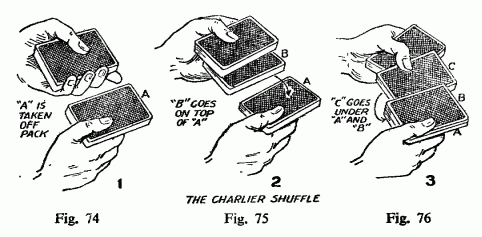
- Raise the left hand slightly and with the left fingers push out a small packet from the bottom of the deck. Take this packet in the right hand on top of the first packet, by lifting the right thumb and then dropping it on top (Fig. 75).
- Lower the left hand a little, push off another small packet from the top with the left thumb, and take it with the right fingers underneath the cards in the right hand (Fig. 76).
- Push out another small packet from the bottom with the left fingers, and take it on top of the cards in the right hand.
- Continue as above until all the cards have been transferred to the right hand.
As has already been stated, this shuffle leaves the deck in the same condition as it would be after one complete cut. By jogging the first packet from the bottom of the deck–that is, by making it protrude inwards from the packet in the right hand–a break can be formed at the jog at the end of the shuffle, and a single cut will return the pack to its original condition.
This shuffle is especially useful for keeping a small packet of cards in sequence, for which purpose neither the overhand nor the riffle shuffle is suitable.
We would emphasize the need for making the shuffle rather slowly and roughly, with great emphasis on the fact that it mixes (do not use the word “shuffle”) the cards thoroughly. [Note: This psychological advice reflects the understanding that spectators associate roughness with thoroughness in card mixing. The suggestion to avoid the word “shuffle” prevents drawing attention to the technique being used. – RJW]
The Cut
It is the invariable rule in games of cards to have the deck cut after it has been shuffled. How far back the custom arose it is impossible to tell, but it is easy to account for the origin of such an exhibition of good faith. “Trust everybody but cut the ca-ards,” as the Irish cynic said. The magician, therefore, must prove his good faith by cutting the cards, which he does–but in such a way as not to disturb the arrangement he has already made. In other words, he uses a false cut. False cuts are made in different ways according to whether the whole deck is to remain in the same order or whether a small packet of cards is to remain intact on the top or on the bottom of the deck.
First Method: Retaining the Whole Deck in the Same Order
- Hold the deck in the left hand, face downwards and near the outer corners, between the third (top) phalanges of the thumb on one side and of the middle finger on the other. The tip of the forefinger rests against the middle of the outer end, and the ring and little fingers rest free. [Note: The specific mention of “third (top) phalanges” refers to the fingertip segments, emphasizing precise grip placement for optimal control. – RJW]
- With the right hand seize the lower half of the deck near the inner corners, between the thumb on one side and the middle finger on the other, the forefinger extended and resting on the back of the top card near the middle of the outer end (Fig. 77).
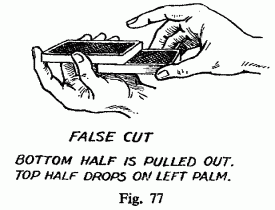
- With a rapid backward and then upward movement of the right hand, pull out the lower half of the deck–the right forefinger sliding on the back of the top card without moving it–and place the packet on the table.
- With the right hand take the remaining cards in the same way, with the same backward and upward movement, and place them on top of the other packet with a slight slap.
Properly timed–that is to say, when you are addressing some quick remark to a spectator and looking at him–this false cut is undetectable. [Note: The emphasis on misdirection through conversation and eye contact reflects core principles of magical performance that remain relevant today. – RJW]
Second Method: Retaining the Whole Deck in the Same Order
- Place the deck on the table at A.
- Cut off a small packet and place it at B, not far from A. Continue in the same way, cutting packets from A and placing them at C, D, E, and F.
A BCDEF
- Pick up packet B and place it on C, pick up BC and place the combined packet on D, and continue in exactly the same way with packets E and F.
- Leaving a few cards at A, place the rest of the cards in your left hand. Begin to square the deck, then pretend to notice that you have overlooked the packet A. Drop all the cards you hold on it, then pick up and square the whole deck.
The action keeps the cards in the same order throughout and is completely deceptive to the uninitiated. [Note: This method demonstrates how a seemingly complex cutting procedure can maintain the original order through careful sequencing of the reassembly. – RJW]
Third Method: Retaining a Small Packet of Cards on the Top of the Deck
- Hold the deck in the left hand by the sides, near the ends, between the thumb and middle finger near the corners, with the forefinger on the back and the ring and little fingers resting free.
- With the right thumb and middle finger at the far end cut off from the top a packet consisting of a few more than the cards to be retained, and place it on the table in front of you.
- Take hold of the free end of the deck with your right thumb and second finger, and with both hands place the pack on the cut. Let the outer sides of both packets come flush, but hold a break at the inner sides with the left thumb tip (Fig. 78). [Note: The “break” is a fundamental concept in card magic – a small gap held between packets that’s invisible to spectators but allows the performer to locate a specific position by touch. – RJW]
- Draw both packets toward you, the action enabling you to get a firm grip of the packets; then lift the whole pack.
- With the right thumb and second finger draw off small packets from the top, letting them fall to the right, one on top of the other, until you reach the break. Finally take the last cards intact and drop them on top of all the rest.
This is one of the easiest and most deceptive false cuts extant. The whole of the action is done by the thumbs and middle fingers only, the cards being held as openly as possible. An even pace, not a rapid one, should be maintained. The break will be found by the right thumb solely by the sense of touch; there is no need to look at the cards. [Note: The emphasis on tactile rather than visual cues reflects advanced card handling principles – developing finger sensitivity allows for more natural-looking performance. When I do this false cut I drop the second packet at an angle, causing the deck to have a jogged condition. I take the break as I pick up the deck and square it up. – RJW]
Fourth Method: Retaining a Small Packet of Cards on the Bottom of the Deck
- Hold the deck in the same position as for the third method.
- With the right thumb and second finger draw off about two-thirds of the pack and place it in front of you.
- Take hold of the free end of the packet in your left hand, between your right thumb and second finger. Place the packet on top of the cut, the outer sides flush, but holding a break at the rear sides as explained in step No. 3 of the third method.
- Draw off the top packet to the break and drop it on the table. Continue drawing off small packets and dropping them one on top of another until the pack is exhausted.
This method of cutting is called a running cut and is in common use among card players. [Note: The “running cut” was indeed a legitimate cutting method used in card games, making this false cut particularly deceptive because it mimics genuine gambling technique. – RJW] The action should be timed at the same pace as the preceding sleight. It is so well covered that the keenest observation from the front will fail to detect any irregularity.
Palm Cut
Retaining a Small Packet on the Top of the Pack. Let us suppose that you have the four aces on the top of the pack and, having executed the overhand break shuffle and retained the aces in that position, you wish to cut the pack yet keep the aces on the top. Make these moves:
- Hold the deck in your left hand, as for dealing, and square the ends with the right thumb and fingers. Palm the aces in your right hand by the second method. It is not necessary to take off only the four aces; just make sure that you lift five or six cards in making the necessary break.
- With the right thumb and fingers cut off about half the deck, and drop the cut in front of you on the table.
- Bring the right hand back squarely over the remainder of the deck in the left hand; grasp these cards, adding the palmed packet, and drop all on the tabled packet.
Immediately after the palmed packet has been added to the cards in the left hand, it is essential that the forefinger be bent inwards so that its tip rests on the middle of the back of the added packet as seen in Fig. 60. [Note: This finger positioning helps square the deck naturally while concealing the addition of the palmed cards, maintaining the illusion of a normal cutting action. – RJW]