
The Hindu Shuffle
The shuffle which goes by this interesting name is an excellent sleight which serves a number of purposes. It may be used as a genuine shuffle, as a method of controlling a card or a number of cards, as a force, or as a glimpse. It is not difficult and it is genuinely deceptive.
- Hold the pack in your left hand between the top phalanges of the thumb and the middle, ring, and little fingers. Place the index finger at the outer end. Hold the pack a little toward your left side, at about waist level, the outer end sloping downwards.
- Grasp the inner end of the pack by its sides between the outermost phalanges of the right thumb and middle finger, with the index finger resting lightly on the top and the ring and little fingers free.
[Note: This grip is crucial for smooth execution. Modern teachers often emphasize keeping the right hand relaxed and using minimal pressure. The grip should feel natural, not cramped.]
- Move the left hand outwards, taking with it a few of the top cards gripped between the thumb and fingers (Fig. 100). When these cards are clear of the pack let them drop on to the palm.
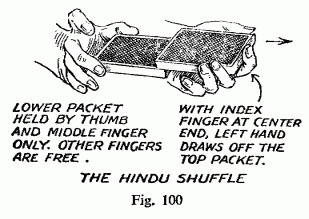
- Move the left hand back to its original position, grasp another small group of cards from the top of the pack in the same way as before–that is, between the thumb and the fingers–then move the left hand outwards and let this packet fall on the first cards drawn off.
- Continue these movements until you have drawn off all the cards held by the right hand.
[Note: Rhythm is key to making this look natural. Avoid mechanical, metronomic timing. Vary the size of the packets slightly and maintain a conversational pace. The shuffle should feel casual and unstudied.]
Do not move the right hand during the shuffle; the left hand does all the work. After a little practice you will be able to draw off a few cards at a time. The slanting position of the pack slides the cards against the left index finger, which acts as a stop and neatly squares them.
To repeat the shuffle at once: Grasp the lower half of the pack at the inner end by the sides, between the right thumb and second finger, and draw the upper half outwards with the left thumb and fingers. Let the upper half fall into the position described in step No. 3 above. Now continue the shuffle exactly as described until you have used all the cards held by the right hand.
Hindu Shuffle Control
Single Card
Proceed as follows:
- Have a card drawn by a spectator. When he has shown it to everyone, begin the Hindu shuffle as already described.
- After you have drawn off several small packets from the top into the left hand, extend the hand and have him place his card on top of these cards.
- Move the left hand back to the right hand to continue the shuffle, placing its cards directly under those held by the right hand so that the outer ends of both packets butt against the left forefinger. Press firmly against the side of the top cards of the lower packet with the tip of the right thumb, which extends below the upper packet, and pick up a card or several cards, holding a break (Fig. 101). Immediately draw the left hand outwards, drawing off a few cards from the top of the upper packet and letting them fall on the cards which remain in the left hand.
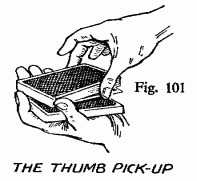
[Note: This is the key move in Hindu Shuffle control. The right thumb’s action of picking up the chosen card (and possibly a few others) must be done smoothly and without hesitation. Modern magicians often practice this move by feeling for the slight difference in thickness when the thumb picks up the extra cards.]
The right hand thus retains its own cards and a few of the top cards of the left-hand packet, the topmost of which is the chosen card. These are separated from those above them by a small break held by the right thumb. The outer ends and the right sides of both packets are flush and the pack presents an ordinary appearance.
- Continue the shuffle in the regular way until the cards above the break have been shuffled into the left hand, then drop those remaining in the right hand on top of all, thus bringing the chosen card to the top.
There should be no hesitation in securing the card from the top of the left-hand packet in step No. 3 above, since it does not matter whether one, two, three, or even more cards are picked up by the thumb.
[Note: This forgiving nature is one of the Hindu Shuffle’s great150est strengths. Unlike some controls that require precise pickup, this method works even if you grab extra cards. This makes it much more practical for performing conditions.]
Several Cards
This procedure is much the same as that used to control a single card:
- Let us say that three cards have been drawn and noted by three persons. Begin the Hindu shuffle by drawing off several packets into the left hand. Extend the hand and have one of the cards replaced on them.
- Continue the shuffle as described in step No. 3 of the single card control, picking up the chosen card and one or two more in the first action of the shuffle, and approach the second person, who holds the second card. Draw off several packets into the left hand; in the next movement, however, do not draw off any cards from the top, but instead let all the cards below the break drop on to those held by the left hand, which you immediately move outwards toward the spectator.
- Have him place his card on top of those you hold in your left hand, thus placing his card above the first man’s card.
- Repeat this procedure exactly–that is, begin the Hindu shuffle, picking up a few of the cards at the top of those held in the left hand between the right thumb and second finger, holding a break with the thumb. Draw off several packets from the top with the left hand as you approach the third person, and when you reach him let the cards above the break fall upon those in the left hand, without drawing any from the top with the left fingers. The third card is thus placed above the second.
- Finally, continue the shuffle by drawing off a packet from the top with the left fingers and at the same time grasping between the right thumb and second finger a few of the top cards of those in the left hand, holding a break above them with the thumb as before.
- Continue the shuffle until all the cards above the thumb break have fallen into the left hand. Drop those that remain on the cards in the left hand; the three chosen cards will be at the top of the pack, but in reverse order to their replacement; that is, the first man’s card will be the third from the top.
[Note: This multi-card control is extremely powerful for group performances. Modern mentalists often use this technique for multiple prediction effects. Remember that the cards end up in reverse order – this is actually useful for many routines where you want to reveal the cards in a specific sequence.]
By using the Hindu shuffle to control a number of cards you save time, an important item, and you also convince those present that the cards are really scattered throughout the pack. This is important, because we must reiterate that, unless you have convinced everyone that the cards really are lost, the most brilliant subsequent discovery will not be impressive.
Hindu Shuffle Force
As we have seen, forcing a card is making a spectator draw the card you want him to take and at the same time convincing him that he has had a free choice. The Hindu shuffle enables you to make a most convincing force.
- Place the card to be forced at the top of the pack.
- Begin a Hindu shuffle by drawing a packet from the top into the left hand in the regular way. In drawing off the second packet, grasp in the usual way a few of the top cards of those now in the left hand, by gripping them between the right thumb and second finger, holding a thumb break.
- Continue the shuffle as usual by drawing off small packets from the top. Invite a spectator to stop the shuffle whenever he pleases. When he says “stop” bring the outer end of the right-hand packet against the left forefinger, flush with the outer end of the packet in the left hand, saying, “Right here.” Drop the cards below the break on to those in the left hand. Extend this hand and ask the spectator to remove the card at the top.
[Note: This force is incredibly deceptive because the spectator genuinely believes they stopped the shuffle at a random point. The key is maintaining the break smoothly throughout the shuffle. Modern performers often add drama by asking the spectator to “stop me whenever you get a feeling” or similar psychological patter.]
This force is completely deceptive. It may be used to force several cards if these are placed at the top of the pack.
Hindu Shuffle Glimpse
Let us say that you have taken a shuffled pack and wish to learn the name of a card before forcing it.
- Begin the Hindu shuffle and, after several packets have been drawn off the top into the left hand, turn the cards held by the right hand so that they face you and are at right angles to those held in the left hand. Rap the inner end of the other packet with these cards (Fig. 102), as if to square them, glimpsing the bottom card at the same time. Continue the shuffle, and drop this card at the top, last of all. This is a natural way of squaring the cards in this shuffle, and it should be used occasionally for that purpose only.
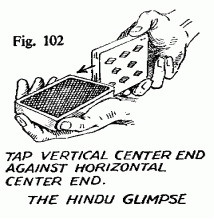
[Note: This glimpse is still used by modern card workers because it appears so natural. The “squaring” action gives perfect cover for the glimpse. Practice this so the glimpse is instantaneous – you should be able to identify the card in a split second without obviously looking.]
Again, a card may have been returned to the pack and you may have controlled it to the bottom by one of the other methods. Glimpse the card in the manner described above and, after one or two more packets have been shuffled into the left hand, drop those held by the right on top. Offer the pack for shuffling, saying, “Perhaps it would be better if you shuffled.” You know the name of the card and are perfectly willing to let him shuffle as long as he likes.
The Step
Assume that a card has been drawn and noted.
- Spring the cards into the left hand, rather slowly, asking the spectator to replace his card. When his hand advances with the card, stop the spring, retaining a part of the pack in the right hand. Say, “Do you want to replace your card here?” and rap the inner end of the cards in the left hand with the knuckles of the right, squaring them. If he replaces the card, well and good; if not, spring a few more cards until he is satisfied, and square these as before. Do not look at your hands while squaring.
[Note: The “step” method creates a natural break without obvious manipulation. Modern performers often use this when they want the spectator to feel completely in control of where their card goes. The casual attitude (“Do you want to replace your card here?”) reinforces the illusion of free choice.]
- Drop the cards remaining in the right hand upon those in the left, so that about a half inch of the packet extends beyond the outer end of the lower packet.
- Place the right hand over the pack to square it, with the thumb resting against the inner end of the lower packet. Press downwards lightly on the outer end of the upper packet before pushing it flush with the lower packet. This forms a break between the two packets at the inner end, which you pick up with the left little finger at the right side near the inner corner.
- Remove the right hand, and the pack appears to be in good condition, although the little finger retains the break.
- Control the card to the top by means of the overhand shuffle or the pass.
Natural Jog
Suppose a card has been drawn.
- Hold the pack in your left hand, as for dealing, but with the index finger curled up around the outer end.
- Cut off the upper half with the right hand by the ends, and have the spectator replace his card on the top of the left-hand packet.
- Hold this packet slanting downwards a little. Toss the right-hand packet upon it, so that its outer end strikes against the middle of the left-hand packet at a slight angle (Fig. 103). The upper half will slide down to the left index finger, which will automatically jog its bottom card at the inner end (Fig. 104).
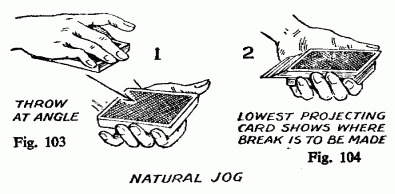
[Note: This “tossing” action is the key to the Natural Jog. It should look casual and undeliberate. Modern teachers often emphasize that the jog happens automatically due to the angle and the left index finger’s position – you don’t need to force it.]
- Press the left thumb on top of the pack, and place the right hand over it, with the fingers at the outer end and the thumb at the inner end. Place the tip of the thumb against the inner edge of the jogged card; press it inwards and upwards flush into the pack, forming a break under the card and holding the break by the left little finger at the right side near the inner corner.
- The card at the top of the packet under the break is the spectator’s card. Bring it to the top by means of the overhand shuffle or the pass. Do not look at your hands at any time but converse naturally as you perform the control.
Twelve-Down Riffle
This is one of the best card controls.
[Note: The Twelve-Down Riffle is considered a classic of card magic. It’s particularly effective because the spectator genuinely believes they’re choosing from a random position in the deck. Many modern magicians consider this one of the most deceptive card controls ever devised.]
- Spread the cards from your left into your right hand as if to have one drawn. Secretly count the first twelve cards, insert your left little finger tip under them to hold a break, and square the deck. Give the impression that you have changed your mind.
- Place your right hand over the pack, with the fingers and the thumb at the ends, and slowly riffle the cards upwards from bottom to top. Ask a spectator on your left to insert his index finger anywhere in the pack as you riffle and remove the card under it. Contrive to have him take one near the middle.
[Note: The “contrive to have him take one near the middle” is crucial. If they stop too early or too late, the effect is less convincing. Modern performers often use psychological techniques like slowing down the riffle in the middle section or making subtle eye contact when they want the spectator to stop.]
- When he has removed a card and all are looking at it, slant the outer end of the pack downwards and lift off the twelve cards above the break between the right fingers and thumb. Hold the pack and the cards with their backs squarely to the spectators, preventing them from noting how many cards you hold in either hand.
- Say, “Kindly replace your card where you took it from.” Extend the left hand a little and have the card replaced at the top of the packet. Drop the cards held in the right hand on top of all, and square the pack meticulously.
The spectators believe the card is lost, for they think it is returned to the haphazard position from which it was taken. You know it is the thirteenth card from the top and are ready to use it for whatever trick you have in mind.
[Note: The beauty of this control is that it gives you a known position (13th from top) while appearing completely fair. This makes it perfect for mathematical tricks, dealing demonstrations, or any effect where you need to know exactly where the card lies in the deck.]