
Thumb Fan
This graceful flourish should be performed with cards in good condition. It is not only pretty to see, but makes possible a version of the famous Diminishing Cards trick.
- Hold the pack at one end between the left thumb, above, and the index finger, below.
- Place the right hand over the pack and press the tip of the thumb firmly against the left side near the outer corner.
- Sweep the thumb in a circle to the right, drawing the top cards with it and spreading those below them in a fan. The thumb exerts a diminishing pressure, as it sweeps to the right, which is quickly learned.
A small fan is formed by placing the tip of the left thumb at the inner right corner in grasping the pack. A larger fan is made by placing the thumb at the inner left corner. To make a rosette, place the thumb at the centre of the pack.
By securing one of the modern colorful bridge packs, many pleasing patterns can be formed by fanning the cards by this method and by grasping the pack at the four corners—in which case, when the outer corners are grasped, the fan is made in reverse, that is, by moving the thumb from right to left.
[Note: The thumb fan is one of the most elegant and practical flourishes in card magic. The reference to “modern colorful bridge packs” indicates the authors were writing during the era when colored card backs were becoming popular, particularly in the 1920s-1940s. The mention of the “famous Diminishing Cards trick” refers to a classic stage illusion where progressively smaller fans of cards are produced, creating a striking visual effect. The versatility described here – creating different fan sizes and patterns – demonstrates how a single technique can be adapted for various performance contexts and aesthetic preferences. – RJW]
Pressure Fan
This modern two-handed method of making a fan insures an absolutely symmetrical fan.
- Hold the pack at the ends between the right thumb and the middle and ring fingers, the first finger curling at the top (Fig. 40).
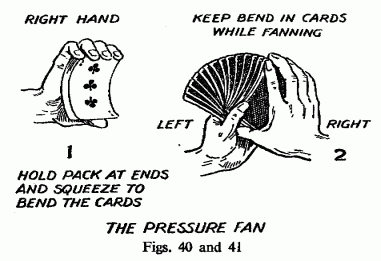
- Place the pack in the crotch of the left hand, the tip of the left thumb resting on the inner left corner at the back, the index finger slanting diagonally across the face of the pack.
- Bend the cards downwards over the left index finger, and spread them in a fan by sweeping the right hand in a circle to the right, allowing the cards to slip from under the finger tips (Fig. 41). [Note: This is something you learn by trial and error. A key thing to note is how your right thumb goes under the left as the fan is completed. – RJW]
This handsome flourish is useful in offering the cards for a choice.
[Note: The pressure fan represents the evolution of card flourishes toward more sophisticated, mechanically precise techniques. The authors’ emphasis on it being a “modern” method indicates this was a relatively recent development in their era, showing how card manipulation was continuously evolving. The guaranteed symmetry of this method makes it particularly valuable for professional presentations where visual perfection is crucial. The technique’s utility “in offering the cards for a choice” demonstrates how flourishes serve both aesthetic and practical purposes in performance. – RJW]
The Fan
This useful method of displaying cards also makes possible a very fine card control and force which we shall mention later.
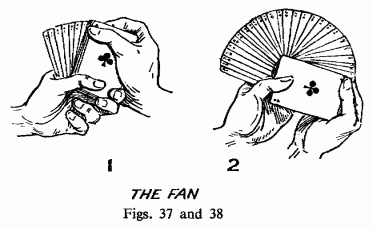
- Hold the pack in the right hand at the inner end, between the index and middle fingers at the face and the thumb on the top, all the fingers paralleling the inner end (Fig. 37).
- Place the left hand at the outer end in the same position, the fingers below and the thumb above and paralleling the end. Spread the cards in an arc with the left thumb as the left fingers draw the cards to the left, the bottom cards being the last to be fanned. Straighten the right fingers so that the cards will pass over them as they are fanned. The completed fan appears as in Fig. 38.
One-Hand Fan
This surprising flourish is particularly effective, the cards spreading into a wide fan in a flash. It may be performed with either hand.
- Hold the pack vertically in the right hand, between the middle phalanges of the middle and ring fingers at one end and the thumb at the other. Rest the index and little fingers lightly at the sides (Fig. 39).
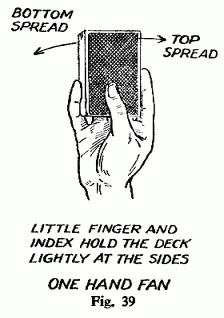
- Hold the pack upright by a pressure of the fingers at the sides and remove the thumb, placing its tip at the middle of the back.
- Remove the index and little fingers, grasping the pack between the tips of the ring and middle fingers at the face and the thumb at the back.
- Spread the cards in a fan by an opposite pressure of the thumb and fingers very similar to that used in snapping the fingers. When the cards are completely fanned they are grasped by the index finger only, at the face, with the fan resting along the palm and the length of the thumb at the back.
A reverse action closes the fan, bringing it to its original position. The knack of making the one-hand fan is not easily acquired, but as with all things practice makes perfect.
[Note: The one-hand fan represents the pinnacle of card flourishes for its era – combining technical difficulty with visual impact. The comparison to finger snapping provides a useful kinesthetic reference point for learning the movement. This flourish became a signature move for many professional card manipulators and stage magicians, as it demonstrates exceptional skill while freeing one hand for other actions. The authors’ candid admission that “the knack…is not easily acquired” reflects their honest approach to instruction – they don’t promise easy mastery but encourage persistent practice. The ability to both open and close the fan smoothly was particularly valuable in performance contexts where the flourish needed to be repeated or used as a transitional element. – RJW]